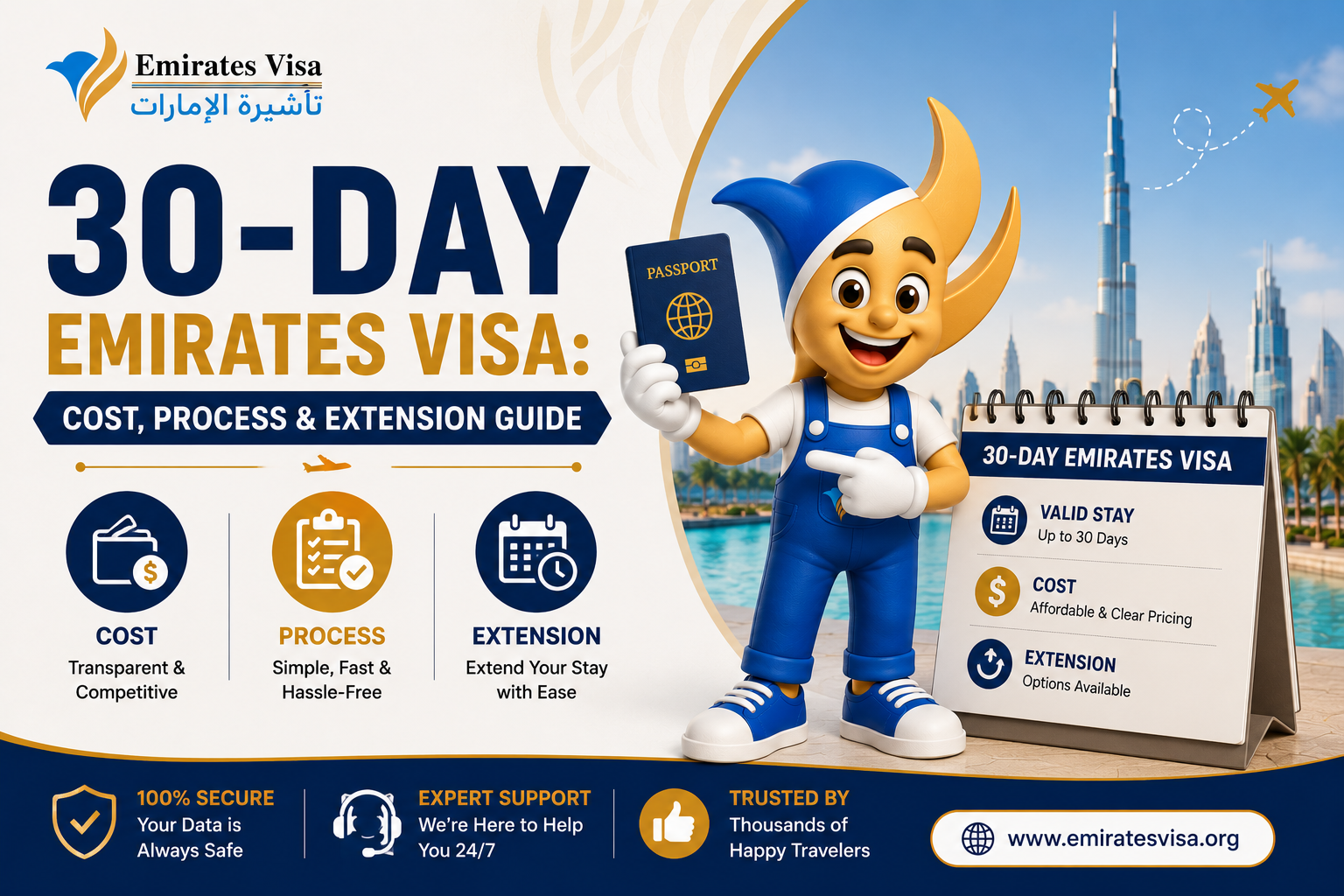
30-day Emirates visa — also commonly searched as the 30-day Dubai visa or 30-day UAE visa — is the most commonly issued UAE visit visa, covering short tourism trips, family visits, and business travel. This guide covers what it actually costs in government fees, how long it's valid, what documents you need, and how to apply and extend it online — verified against GDRFA Dubai and ICP Smart Services published information.
It's worth understanding this visa properly before you apply, because the two most common mistakes — confusing entry validity with stay duration, and assuming a single extension covers unlimited additional time — are also the two most common reasons travellers end up facing unexpected overstay fines. Both are covered in detail below, along with a full breakdown of what you'll actually pay once government fees, VAT, and any processing add-ons are added together.
Table of Contents
- Types of 30-Day Emirates Visas
- Entry Validity vs. Stay Duration (Important Difference)
- 30-Day Emirates Visa Processing Time
- 30-Day Emirates Visa Cost and Fees (2026 Updated)
- 30-Day vs. 60-Day Emirates Visa: What’s the Difference
- Documents and Requirements
- Who Can Apply
- Worked Example: Application Timeline
- Tips for Faster Approval
- Extension Rules
- Overstay Fines
- Common Rejection Reasons
Types of 30-Day Emirates Visas
Entry Validity vs. Stay Duration (Important Difference)
These are two different things, and mixing them up is one of the most common visa mistakes:
- Entry validity — the window in which you must enter the UAE after the visa is issued. For the 30-day visa, this is 60 days from the date of issue.
- Stay duration — once you enter, you can remain in the UAE for up to 30 days from your entry date, not from the issue date.
Example: a visa issued on 1 July is valid for entry until around 30 August. If you enter on 15 August, your 30-day stay period runs from that date, giving you until roughly 14 September before you need to exit, extend, or convert your status.
30-Day Emirates Visa Processing Time
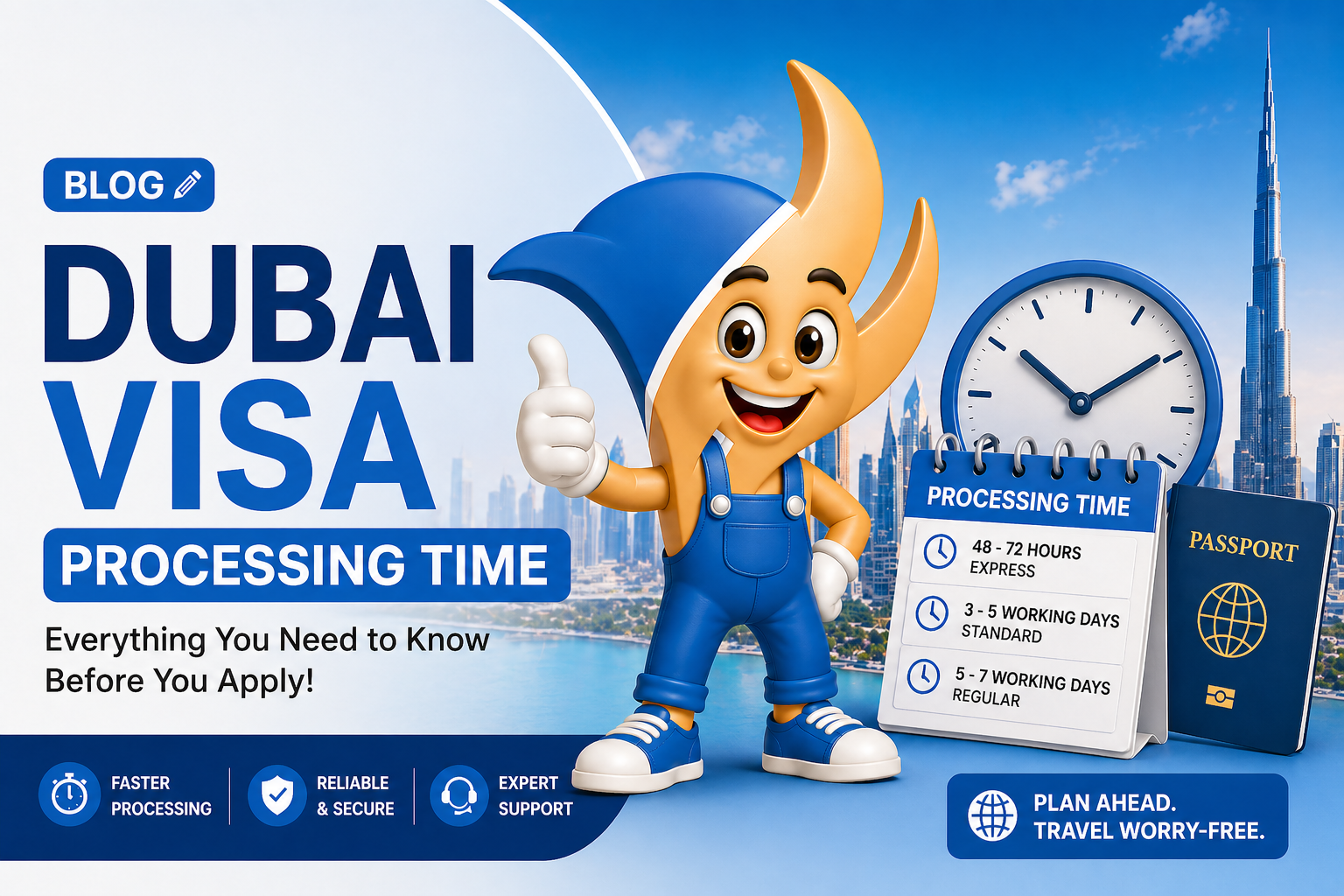
- Standard processing: 24-72 hours
- Express processing: 12-24 hours
- Urgent processing: 6-12 hours — often same-day if submitted early in the day
Actual visa processing time can vary based on document accuracy, nationality, and background verification — express and urgent options carry an additional government/service fee.
30-Day Emirates Visa Cost and Fees
| Item | Approx. Cost (AED) | Notes |
|---|
| 30-day single entry visa (govt. fee) | AED 252 + 5% VAT | Standard processing |
| 30-day multiple entry visa (govt. fee) | AED 452 + 5% VAT approx. | Standard processing; confirm current fee |
| Express processing add-on | AED 150–300 approx. | Reduces processing to 12–24 hours |
| Urgent processing add-on | AED 300–500 approx. | Reduces processing to 6–12 hours |
| 30-day extension | From AED 600 + 5% VAT | In-country, before expiry |
Fees verified against GDRFA Dubai and ICP Smart Services published schedules as of July 2026. Government fees change periodically — always confirm the current fee before applying, and note that fees may differ slightly if applying through a licensed visa agency versus directly.
30-Day vs. 60-Day Emirates Visa: Key Differences
| 30-Day Visa | 60-Day Visa |
|---|
| Stay duration | Up to 30 days from entry | Up to 60 days from entry |
| Approx. government fee | AED 252 + 5% VAT (single entry) | AED 352 + 5% VAT (single entry) |
| Best for | Short tourism trips, quick business visits | Longer stays, extended family visits, longer business trips |
| Extension | Extendable in-country, 30 days at a time | Extendable in-country, subject to its own terms |
If you're unsure which to choose: the 60-day visa costs more upfront but avoids an extension fee if you already know you'll need more than 30 days. For trips under three weeks, the 30-day visa is the more cost-effective choice.
Documents Required for 30-Day Emirates Visa
- Passport valid for at least 6 months from the date of entry
- Recent passport-size photograph with a white background
- Confirmed return or onward travel ticket (recommended, sometimes required)
- Proof of accommodation — hotel booking or host's address
- For some nationalities: proof of funds, national ID, or existing residence permit copy
Eligibility: Who Can Apply
The 30-day visa is available to tourists, business visitors, and those making family visits, subject to nationality-based eligibility and travel history. Some applicants may require additional sponsor verification or background checks depending on nationality.
How to Apply
- Step 1: Complete the online application with personal and travel details.
- Step 2: Upload your passport copy and photograph.
- Step 3: Pay the government fee (plus express/urgent add-on if applicable) through a secure payment method.
- Step 4: Receive your approved eVisa by email as a PDF — no embassy visit or physical stamping required before travel.
Worked Example: Applying for a Standard 30-Day Visa
To make the timeline concrete, here's what a typical standard-processing application looks like from start to finish:
- Day 1: Applicant submits the online form with passport and photo, selects standard processing, and pays the government fee.
- Day 1-3: Application is reviewed; most standard applications with clean documents clear within 24-72 hours.
- Day 3: Approved eVisa PDF arrives by email — this is the document to carry (digitally or printed) when boarding and on arrival.
- Entry: Applicant has 60 days from the issue date to enter the UAE; the 30-day stay clock starts on the actual entry date, not the issue date.
If a faster timeline is needed — for example, booking travel within a week — switching to express or urgent processing at the time of application is the more reliable option, rather than submitting standard processing and hoping it clears early.
Tips for Faster Approval
- Submit a clear, uncropped passport photo page scan — blurry or angled scans are one of the most common causes of processing delays, not just rejections.
- Make sure your photo meets the white-background, passport-size specification exactly; visa systems flag mismatched photo specs for manual review, which adds time.
- Double-check your name spelling matches your passport exactly, including middle names — a mismatch between the application and passport is a common, avoidable rejection trigger.
- If you've previously visited the UAE, resolve any prior overstay or unpaid fine before applying — outstanding issues from a previous trip will hold up a new application regardless of how clean the new documents are.
- Apply with enough buffer before travel — even standard 24-72 hour processing can extend during peak seasons, so applying at least a week ahead avoids needing to pay for urgent processing unnecessarily.
30-Day Emirates Visa Extension Rules
The 30-day visa can be extended without leaving the UAE, through an in-country extension processed via GDRFA or ICP, for an additional 30 days per extension. Multiple extensions may be possible depending on visa type and current GDRFA/ICP policy — confirm the maximum number of extensions allowed for your specific case before relying on it. Apply for the extension before your current visa expires; extensions filed after expiry are treated as an overstay case, not a routine renewal.
Read the full blo on UAE Visa Extension
Overstay Fines and Penalties
Overstaying a 30-day Emirates visa carries a fine of AED 50 per day, starting from day one — there is no grace period. Fines accumulate daily and must be cleared before you can exit the UAE or apply for a new visa.
Common UAE Visa Rejection Reasons
- Incorrect or unclear document scans, especially passport photo pages
- Previous UAE overstay or unresolved immigration violations
- Security or background verification issues
- Duplicate or already-active visa applications on the same passport
Double-checking document quality and confirming you have no unresolved prior UAE immigration issues before applying prevents most rejections.
EXPERT SUPPORT
📋 UAE Visa Issue? We’ve Got You Covered
Emirates Visa handles all four scenarios — approved, rejected, cancelled, or no record found. We calculate any existing fines, guide you on the best solution, and process your case quickly without delay.
WhatsApp Us Email Us Get Help Now

 TOURIST VISA