Most people only think about UAE visa overstay rules when it is already too late. The visa expiry date passed, the flight got delayed, or plans simply changed — and now the question is: how much do I owe, and what happens next?
This guide answers that question directly. It covers the current AED 50 per day fine structure, the full grace period rules by visa type, what happens at the airport if you have outstanding fines, and how to resolve everything before you leave. It also includes the latest 2026 updates, including the end of the emergency waiver period that affected thousands of stranded tourists.
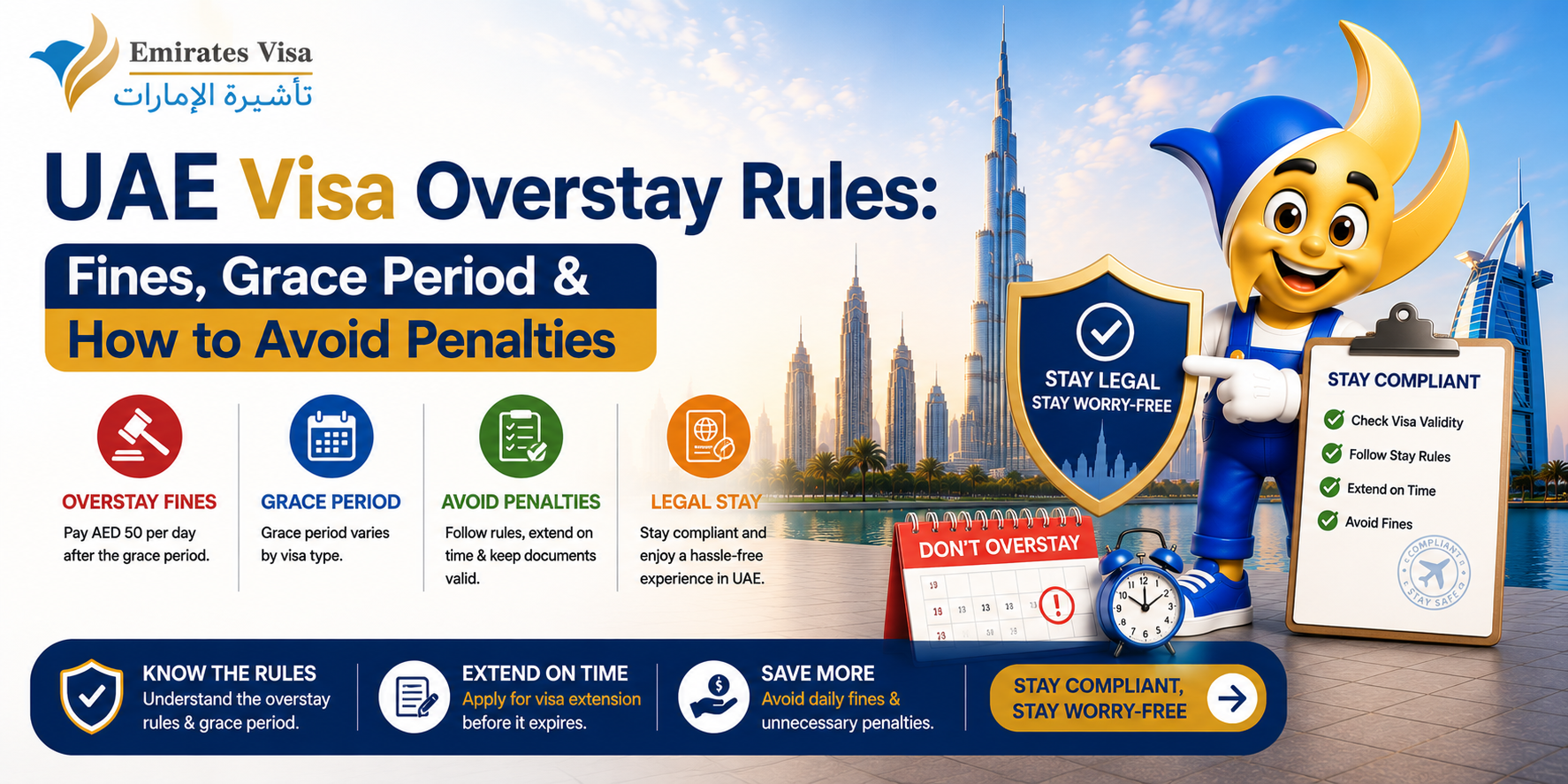
Important – February 2026 Update: The UAE unified its overstay fine at AED 50 per day across all visa types and all emirates. The previous 10-day grace period for tourist visas has been officially removed. Fines begin accruing from the very next day after your visa expires.
📋 Table of Contents
- What Is a UAE Visa Overstay?
- UAE Visa Overstay Fines 2026 — Complete Breakdown
- Grace Period Rules by Visa Type
- What Happens If You Overstay
- What Actually Happens at the Airport — Step by Step
- Does Overstaying Lead to a Blacklist or Entry Ban?
- Is There a UAE Visa Amnesty in 2026?
- How to Check Your UAE Overstay Fine Balance
- How to Pay Your UAE Overstay Fine
- What Is "Gulf Fine 91" and "UAE Fine 02"?
- What Is a UAE Out-Pass (Exit Permit)?
- Can Overstay Fines Be Waived?
- How to Avoid an Overstay — Practical Checklist
- Visa Extension vs. Overstay — Cost Comparison
- Already Overstayed? Step-by-Step Action Plan
What Is a UAE Visa Overstay?
A UAE visa overstay occurs when you remain in the country beyond the expiry date of your visa or permitted duration of stay. This applies to every visa category: 30-day tourist visas, 60-day visit visas, multi-entry visas, and residence visas.
It does not matter whether the overstay was intentional or accidental. The fine accrues automatically in the ICP and GDRFA immigration databases from the day after expiry. No notification is sent to you. By the time you check, the amount may already be significant.
📌 Latest Update — 21 April 2026
The ICP confirmed on 21 April 2026 that the temporary emergency grace period granted to stranded tourists and visit visa holders has now officially closed. Standard fines of AED 50 per day have resumed from this date for anyone whose visa lapsed after 28 February 2026 and who has not yet exited the UAE or regularised their status. No extension of the waiver has been announced.
Here is the full timeline of the 2026 emergency period so you can understand what applied to whom and when:
- 28 February 2026: Regional airspace disruptions began due to the Iran conflict, causing mass flight cancellations across UAE airports.
- 4 March 2026: ICP announced an emergency overstay fine waiver for tourists, visit visa holders, and out-pass holders stranded due to cancelled flights. Fines were automatically suppressed from 28 February onward for qualifying individuals.
- 31 March 2026: The emergency grace period for residents with expired permits who were stranded abroad also closed. Standard entry requirements resumed from 1 April 2026.
- 21 April 2026: ICP confirmed the four-week tourist visa grace period has now closed. Standard AED 50 per day fines resumed in full.
If your visa lapsed after 28 February 2026 and you are still in the UAE as of late April 2026 or beyond, the emergency waiver no longer applies to you. Standard AED 50 per day fines are accruing. You need to settle your balance and exit, or regularise your status through ICP or GDRFA.
UAE Visa Overstay Fines: The Complete Breakdown
The unified fine structure introduced in February 2026 is straightforward. One rate. All visa types. All emirates.
Daily Fine Rate
- AED 50 per day — starts the day after your visa expires
- Applies to all visa types: tourist, visit, employment, residence
- Applies uniformly across all seven emirates
- Fines accrue automatically — no warning or notice is sent
Out-Pass Fee (Overstays Exceeding 30 Days)
If your overstay exceeds 30 days, you must obtain an exit permit (out-pass) before you can leave the UAE. This is a separate fee of approximately AED 250–300, payable through GDRFA (Dubai-issued visas) or ICP (all other emirates. Emirates Visa also provides services to assist with overstay clearance.
Fine Calculation Table (AED + USD)
| Days Overstayed | Fine (AED + USD) | Out-Pass Fee | Total Minimum |
|---|
| 1 day | AED 50 (~$13.60) | — | AED 50 |
| 7 days | AED 350 (~$95) | — | AED 350 |
| 14 days | AED 700 (~$190) | — | AED 700 |
| 30 days | AED 1,500 (~$408) | — | AED 1,500 |
| 31+ days | AED 1,550+ (~$422+) | ~AED 250–300 | AED 1,800+ |
| 90 days | AED 4,500 (~$1,225) | ~AED 250–300 | AED 4,750+ |
💡 Overstay Formula: Days overstayed × AED 50 = total fine. If over 30 days, add approx. AED 250–300 for the out-pass.
Grace Period Rules: Full Breakdown by Visa Type
This is one of the most searched and most misunderstood topics on this subject. The answer is not a single number — it depends on your visa category. Here is the complete picture:
| Visa / Resident Category | Grace Period | Notes |
|---|
| Tourist / visit visa (all types) | No grace period | Zero — fine starts day 1 after expiry |
| Standard employment visa | 30–60 days | Starts from cancellation date (MOHRE) |
| Skilled professional (MOHRE Level 1–2) | Up to 180 days | Based on occupational classification |
| Green Visa holder | Up to 180 days (6 months) | Self-sponsored; confirmed by ICP |
| Golden Visa holder | Up to 180 days (6 months) | Applies to holder and family members |
| Widow / divorcee of UAE resident | 1 year | From date of death or divorce |
| Student (university-sponsored) | Up to 180 days | After completing studies |
Important Notes on Residence Visa Grace Periods
For residents, the grace period after visa cancellation depends on MOHRE occupational skill level classification. The five visa categories that qualify for the maximum six-month grace period under ICP rules are:
- Golden Residency visa holders and their family members
- Green Residency visa holders and their family members
- Widows or divorcees of a UAE-resident foreigner
- Students sponsored by UAE universities after completing their studies
- Residents in skilled professions classified under MOHRE Levels 1 and 2
Standard employment visa holders (MOHRE Levels 3–5) typically receive 30 to 60 days. Always check the exact date on your cancellation form — it will state the deadline by which you must exit or regularise your status.
Free zone employees track their grace period from the residence permit cancellation date. Mainland employees track it from the labour card or work permit cancellation date.
What Happens If You Overstay: Consequences at Every Stage
The fine is only the first consequence. Here is what actually happens as an overstay extends:
At the Airport — Smart Gate Blocks
Every UAE airport — Dubai, Abu Dhabi, Sharjah, and all regional airports — flags outstanding fines automatically. You will not be allowed to check in or pass through immigration until all balances are cleared. This block is enforced even for small unpaid amounts.
Settle all fines and obtain any necessary out-pass at least 48 hours before your flight. Last-minute payments cause technical delays even after payment is confirmed.
What Actually Happens at the Airport — Step by Step
Most articles tell you that you will be stopped. Here is exactly what happens when you are standing there with your bags:
Step 1 — Check-in Counter: The airline scans your passport before issuing a boarding pass. Their system flags outstanding fines. If you have an unpaid balance, the boarding pass does not print. You will be directed to the immigration counter.
Step 2 — Immigration Counter: An officer pulls up your record in real time — visa expiry date, number of overstay days, and exact fine amount. You will not pass through until the balance is zero.
Step 3 — Payment: If your overstay is under 30 days, you can pay at the airport fine counter (cash or card). This is the riskiest option — queues are long and system lags happen. If payment does not reflect immediately, you miss your flight.
Step 4 — Overstay Over 30 Days with No Out-Pass: You will be turned away entirely. No airport counter payment fixes this. You must leave, obtain the out-pass from an Amer centre, and rebook your flight.
Step 5 — Cleared: Once payment is confirmed and your record updates, immigration stamps your passport. Keep your payment receipt until you have fully exited UAE airspace.
Airport payment is a last resort, not a plan. Pay online at least 48 hours before your flight. Get your out-pass before you pack — not at the departure gate.
Travel Ban
Prolonged or repeated overstays can result in a UAE entry ban. Depending on severity, this may be temporary (one to three years) or permanent. The UAE's immigration system is increasingly integrated with GCC databases — a serious overstay record can affect entry into Saudi Arabia, Qatar, Oman, Bahrain, and Kuwait as well.
Deportation
Extreme overstays, particularly those combined with unpaid fines, can lead to deportation. This is rare for short, first-time violations but is a documented outcome for multi-month cases.
Does overstaying in UAE automatically lead to a blacklist or entry ban?
No — a short first-time overstay does not automatically result in a blacklist or permanent entry ban. The standard consequence is the AED 50/day fine, which must be settled before departure.
However, a UAE entry ban can be imposed in these situations:
- Prolonged overstay (typically 3+ months) combined with unpaid fines
- Repeated overstay violations across multiple visits
- Deportation order issued by GDRFA or ICP
- Overstay combined with other immigration or labour violations
Once a ban is in place, it is registered in the GCC-wide immigration database and can affect entry into Saudi Arabia, Qatar, Oman, Bahrain, and Kuwait — not just the UAE.
Is there a UAE visa amnesty in 2026?
No general amnesty programme is currently active as of June 2026.
- The 2026 UAE amnesty ran until 31 December 2024 and allowed overstayers to exit or regularise without fines.
- A targeted emergency waiver ran from 4 March 2026 to 21 April 2026 (tourist visas) for those stranded by airspace disruptions — this has now closed.
- No new amnesty has been announced for the rest of 2026.
Do not wait for an amnesty. Fines are accruing daily. The correct action is to pay your balance through ICP or GDRFA and exit or regularise your status now.
What is a UAE Out-Pass (Exit Permit)?
If your overstay exceeds 30 days, you cannot depart the UAE without first obtaining an Exit Permit — commonly called an "out-pass." This is a separate document from your visa and is required by immigration at all departure points.
Cost: AED 250–300 (GDRFA Dubai) / AED 200–250 (ICP — other emirates)
How to apply:
- Dubai: Visit any Amer Centre with your passport. Processing is same-day in most cases.
- Abu Dhabi / Sharjah / other emirates: Apply through an ICP-authorised typing office or ICP Smart Services portal.
- Contact Emirates Visa for out pass.
Processing time: Same day to 24 hours in person. Allow 2–3 working days if applying online.
Important: Obtain your out-pass before going to the airport. Airport counters cannot issue out-passes — they can only accept fine payments for overstays under 30 days.
How to check your UAE overstay fine balance
For Dubai-issued visas (GDRFA):
- Go to GDRFA Site → Services → Fine Enquiry
- Enter your passport number and nationality
- Your balance and fine start date will display
For all other emirates (ICP):
- Go to ICP Site → ICP Smart Services
- Select "Residency Enquiry" or "Fine Check"
- Enter Emirates ID or passport number
Via app: Download UAE Pass → linked directly to both portals → check and pay in one step.
Check at least 48 hours before your flight. System processing delays mean a fine paid on the day of travel may not clear in time for smart-gate departure.
How to Pay Your UAE Overstay Fine
Online Payment
- ICP Smart Services portal: — for all emirates except Dubai
- GDRFA Dubai portal: — for Dubai-issued visas
- UAE Pass mobile app — links to both portals
In-Person Payment
- Amer Centres across Dubai
- Authorised typing offices
- Airport immigration counters — for overstays under 30 days only
- GDRFA or ICP offices — required if you need an out-pass (overstay 30+ days)
Pay at least 48 hours before your flight. Smart-gate systems need time to process the payment and clear the departure flag. Last-minute payments — even confirmed ones — can still cause boarding delays.
What is "Gulf Fine 91" and "UAE Fine 02"?
These are official GDRFA and ICP fine reference codes that appear on immigration records and payment portals.
- Gulf Fine 91 = GDRFA Dubai's internal code for visa overstay. If your Dubai visa is overstayed, this code appears on your GDRFA record.
- UAE Fine 02 = ICP's fine code for overstay penalties across all other emirates (Abu Dhabi, Sharjah, etc.). When paying online, you may be asked to enter this code to locate your fine record. Both resolve to the same AED 50/day overstay penalty.
Can Overstay Fines Be Waived?
Yes, in limited circumstances. The standard waiver process exists outside of any emergency measures and is reviewed case by case.
Valid Grounds for a Waiver Application
- Medical emergencies — supported by hospital reports
- Death of an immediate family member — supported by a death certificate
- Confirmed flight cancellations or travel disruptions beyond your control
⚠ Important Update: The 2026 emergency waiver for airspace-disruption-related overstays officially closed on 21 April 2026 (tourist visas) and 31 March 2026 (residence visas). As of June 2026, no general amnesty programme is active. The 2024 amnesty ended on 31 December 2024. Do not wait for another amnesty.
How to Apply
- Collect supporting documents (hospital letter, flight cancellation confirmation, etc.)
- Submit your waiver request through the relevant authority — GDRFA for Dubai visas, ICP for all other emirates
- Allow several working days for review — this is not an instant process
How to Avoid an Overstay: Practical Checklist
- Set a calendar alert 14 days before your visa expires
- Check your visa expiry date through the official ICP or GDRFA portal
- If you need more time, apply for an extension before expiry — never after
- If extension is not possible, book and confirm your exit before the expiry date
- If leaving employment, confirm your employer has filed the work permit and visa cancellation
- Pay any fines at least 48 hours before your flight, not at the airport counter
Visa Extension vs. Overstay: A Critical Distinction
A visa extension is a legal application to extend your permitted stay, made before your current visa expires. It is completely lawful, costs a set fee, and avoids all overstay consequences.
An overstay is staying beyond your visa expiry without a valid extension or exit. Even one day past expiry counts under the current 2026 rules.
Extension vs. Overstay — Real Cost Comparison
If your visa is about to expire and you are wondering whether the fine is really that bad compared to the cost of an extension, here is the exact answer:
| Factor | Visa Extension | 30-Day Overstay |
|---|
| Cost | AED 600–900 (approx) | AED 1,500 + AED 250–300 out-pass |
| Record Impact | None | Flagged in immigration system |
| Future Visa Risk | Zero | Higher rejection chance |
| Processing Time | 24–48 hours (online) | Fine payment + out-pass process |
| Stress Level | Low | High |
A standard 30-day extension costs roughly AED 600–900 depending on visa type and service provider. Thirty days of overstay at AED 50 per day is AED 1,500 — before the out-pass fee of AED 250–300 on top. You pay more to overstay, get a record flag, and face higher rejection risk on future visa applications. Extending is always the smarter option if you are still within your validity.
Can You Extend a Dubai Visit Visa From Inside the UAE?
Yes. A 30-day extension of a tourist or visit visa can be applied for from inside the UAE through authorised service providers before your current visa expires. Extensions are subject to eligibility and approval, and are not guaranteed.
If you are already in an overstay situation — or want to avoid one — Emirates Visa offers UAE visa overstay assistance, including guidance on fine calculation, extension eligibility checks, and out-pass support. Our team can help you understand your options and take the right steps before your situation escalates.
Already Overstayed? Here Is Your Step-by-Step Action Plan
Most content on this topic is written for people who have not overstayed yet. If you are reading this after the fact — do not panic. Here is exactly what to do:
- Check your fine balance now through the official ICP or GDRFA portal. Know the exact amount before you do anything else.
- If your overstay is under 30 days, pay your fine online or at an Amer centre. Keep your payment receipt.
- If your overstay exceeds 30 days, obtain an Exit Permit (out-pass) first — approximately AED 250–300 — from an Amer centre or through the ICP portal. You cannot depart without this.
- Pay all outstanding fines and confirm the payment is reflected in the system at least 48 hours before your flight.
- At the airport, present your payment receipt if asked. The immigration officer will verify your cleared status and stamp your passport.
- If your situation is more complex — long-term overstay, expired documents, or an employment-related issue — consult an authorised immigration typing centre or PRO service before attempting to travel.
⚠ Key Rule: Sort everything before you go to the airport. Do not rely on airport counters as your payment plan — especially if your overstay exceeds 30 days.
Disclaimer: UAE visa and immigration rules are subject to change without prior notice. All information in this article is based on official ICP and GDRFA guidance current as of June 2026. Always verify the latest rules directly through official UAE government sources before making any immigration decision. This article is for informational purposes only and does not constitute legal or immigration advice.

 TOURIST VISA