If you're living and working in Saudi Arabia, Qatar, Kuwait, Bahrain, or Oman and planning a trip to the UAE, you don't apply for a standard tourist visa. You need a specific category called the eVisa for GCC Residents — built for exactly this situation: expatriates who hold a valid residence permit in one Gulf country and want to visit another. A lot of guides online call this a "GCC resident visa on arrival," but that's not accurate, and assuming it is the most common reason people show up at the airport without the paperwork they actually needed.
It's a small but important distinction. The UAE treats GCC nationals, GCC residents, and everyone else as three separate categories, each with completely different entry rules. Get the category wrong and you either pay for a visa you didn't need, or — worse — arrive without one you did. This guide covers exactly who qualifies, what it costs, how long it lasts, and the step-by-step process through GDRFA (if you're entering via Dubai) or ICP (for every other emirate), along with the mistakes that most often cause delays.
Table of Contents
UAE Visa for GCC Residents – Requirements & Eligible Nationalities
A "GCC resident" in this context means something specific: you're not a citizen of Bahrain, Kuwait, Oman, Qatar, or Saudi Arabia, but you hold a valid residence permit in one of them — typically through employment. This is different from a GCC national, and the rules for each are completely different (more on that below).
To qualify for the eVisa, you need to meet three conditions:
- A GCC residence permit valid for at least 1 year from your intended UAE arrival date
- A passport valid for at least 6 months from your arrival date
- A profession that's on the approved list for this visa category — GDRFA and ICP evaluate this as part of the application, so it isn't guaranteed just because your residency and passport meet the other two conditions
Here's the part that surprises a lot of applicants: your passport nationality itself generally doesn't disqualify you. Unlike the standard UAE visa-on-arrival system — which is restricted to specific nationalities holding specific Western visas — the GCC resident eVisa is available to residents of any nationality, provided the residency and profession conditions are met. There's one exception worth knowing: nationals of Pakistan, Afghanistan, Iraq, and Iran must submit a copy of their national ID alongside their passport as an additional document. Every other nationality follows the same visa document checklist.
This matters a lot if you're an Indian national working in Saudi Arabia, Qatar, or the UAE's other Gulf neighbours — your Indian passport doesn't limit your eligibility here the way it can for other UAE visa routes. What determines whether you qualify is your residency status and your profession, not where your passport is from.
The profession-approval condition is the one applicants tend to overlook, because it isn't something you control directly — it's evaluated by GDRFA or ICP as part of processing your application, based on the profession listed on your GCC residence permit. There's no publicly published master list ranking every profession as approved or excluded, which is exactly why the application form asks for these details rather than treating the visa as automatic once residency and passport validity are confirmed. If your profession isn't accepted, the application can be rejected even though your residency and passport otherwise meet every requirement — which is one more reason to apply with a comfortable buffer before your travel date rather than a day or two out.
UAE eVisa for GCC Residents – Fees & Processing Time
The official government fee, per GDRFA Dubai's service catalog, is AED 250 plus 5% VAT — a total of roughly AED 262.50 for the base application.
A few things worth knowing before you pay:
- If you apply through a typing centre or a third-party visa service rather than directly through GDRFA or ICP, expect an additional service fee on top of the government charge. Some agencies quote an all-in price closer to AED 270–300 — always confirm whether VAT and service fees are already included in any quote you're given.
- The fee applies per applicant. If you're travelling with family, each accompanying dependant needs their own application and their own fee — there's no bundled family rate.
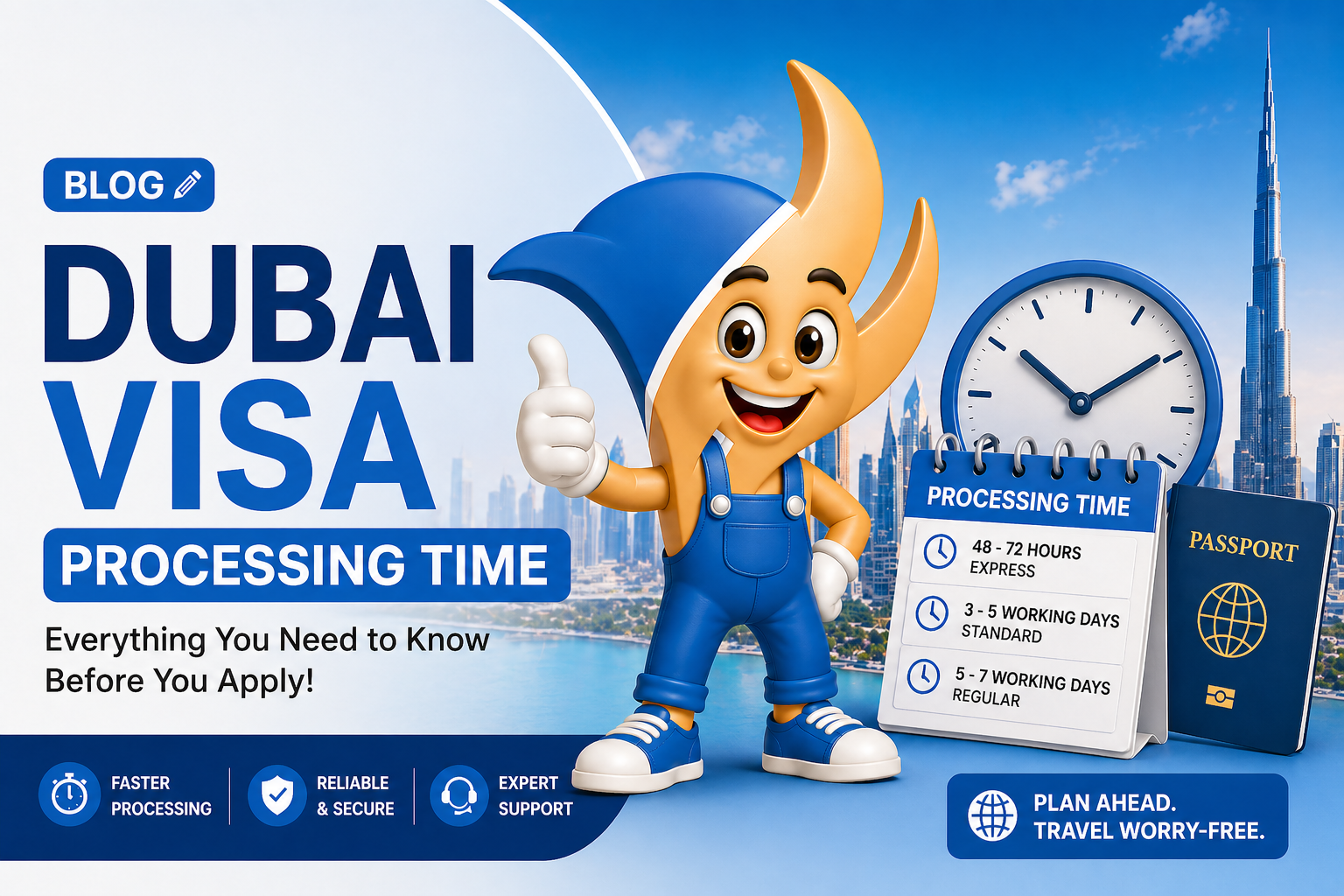
- Processing is typically completed within a few working days once your documents are submitted correctly and your profession clears evaluation. Some service providers advertise approval within 24 to 72 hours for straightforward applications, but that's not a guarantee — apply at least several days before you intend to travel rather than right before departure.
There's no official express or fast-track tier publicly listed for this specific visa category the way there is for some other UAE visa types, so build your timeline around the standard processing window rather than assuming an expedited option will be available if you're running late. If your travel dates are fixed and non-negotiable — a wedding, a business meeting, a flight already booked — treat the application as one of the first things you handle, not one of the last.
How to Apply for the UAE eVisa as a GCC Resident (GDRFA & ICP)
Which portal you use depends on where you're entering the UAE — not where you live. If you're flying into Dubai, apply through GDRFA. If you're entering through any other emirate (Abu Dhabi, Sharjah, Ajman, Ras Al Khaimah, Fujairah, or Umm Al Quwain), apply through ICP Smart Services.
1. Choose your channel: GDRFA Dubai for Dubai entry, or ICP Smart Services for every other emirate.
2. Log in or register. Both portals support UAE Pass login; new users can also register directly with an email and mobile number.
3. Search for the correct service. On GDRFA, look for "Entry Visa for Residents of GCC Countries." On ICP, search for "Issue Entry Permit for GCC Resident."
4. Gather your documents before you start: a passport copy (6+ months validity), a copy of your GCC residence permit, and a recent colour photograph on a plain white background. If you're unsure your photo meets the technical specs — dimensions, background, file size — check our full UAE visa photo size guide before uploading, since photo rejections are one of the most common reasons applications get delayed.
5. If you're applying for accompanying family members, prepare proof of kinship documents (marriage certificate for a spouse, birth certificate for children) for each dependant.
6. Pakistani, Afghan, Iraqi, and Iranian nationals should also have a copy of their national ID ready to upload alongside the passport.
7. Complete the application form with your travel and passport details, upload all documents, and pay the fee online by card.
8. Wait for approval. The eVisa is sent to the email address on your application — there's no physical stamp or in-person collection step.
9. Print or save the digital eVisa. Carry a copy (digital or printed) when you travel, along with your passport and residence permit, since immigration may ask to see the underlying documents at the border even after online approval.
UAE eVisa for GCC Residents – Validity, Extension & Renewal
This is where a lot of confusion creeps in, because there are actually two separate 30-day periods to keep track of, not one.
Entry window: your approved eVisa is valid for 30 days from the date it's issued. You need to actually enter the UAE within that 30-day window — the eVisa doesn't sit valid indefinitely waiting for you to book a flight.
Stay duration: once you enter, you're permitted to stay for 30 days from your date of entry. This is a separate clock that only starts once you're actually in the country.
The stay can be extended once for an additional 30 days, bringing your maximum possible stay to 60 days total. Visa extensions are filed through the same portal you applied on (GDRFA or ICP), and — as with other UAE visa categories — you should apply for the extension before your current stay expires, not after. If you overstay without filing an extension, standard UAE overstay rules apply: a fine of AED 50 per day starting from day one, with no grace period. There's no cap that limits how high this can accumulate the longer you stay past your permitted date, so file the extension early rather than risk it. Full details on the extension process itself are in our visa extension and overstay guide.
This isn't a renewable long-term visa in the way a residence visa is. There's no multi-year validity and no renewal process — if you want to visit the UAE again after your eVisa (and any extension) expires, you apply for a fresh eVisa each time.
GCC Resident vs. GCC National – Why UAE Entry Rules Are Different
This distinction is the single biggest source of confusion on this topic, so it's worth being explicit about it.
GCC nationals
— citizens of Bahrain, Kuwait, Oman, Qatar, or Saudi Arabia — enter the UAE completely visa-free. No application, no fee, no advance approval. They simply present their passport or national ID card at the border.
GCC residents
— non-GCC-nationals who hold a residence permit in one of those countries — do not get this treatment. Holding a residence permit in Saudi Arabia or Qatar, for example, doesn't extend the same visa-free privilege to you, even though you legally live there. You need the eVisa covered in this guide, applied for in advance.
| GCC National | GCC Resident |
|---|
| Who this is | Citizen of Bahrain, Kuwait, Oman, Qatar, or Saudi Arabia | Non-citizen expat holding a residence permit in one of those countries |
| Visa required? | None — visa-free entry | Yes — eVisa for GCC Residents, applied for in advance |
| Document at border | Passport or national ID card | Passport + approved eVisa + GCC residence permit |
| Fee | None | AED 250 + 5% VAT per applicant |
| Stay duration | Not visa-restricted | 30 days, extendable once to 60 days total |
It's also worth separating this from the general UAE visa-on-arrival system, which is a different product entirely — that one is based purely on your passport nationality and, for some nationalities, an existing Western visa or residence permit. GCC residency doesn't make you eligible for visa-on-arrival, and holding a qualifying Western visa doesn't exempt you from needing the GCC resident eVisa if your only relevant residency is in the Gulf. The two systems don't overlap, and mixing them up is exactly what leads to a rejected boarding pass at check-in.
A related question worth answering directly: what if you're a dual case — say, an Indian passport holder with both a valid Schengen visa and a Saudi residence permit? In that scenario you'd typically qualify for the standard 14-day Indian visa-on-arrival route through your Schengen visa, independently of your Saudi residency. The two eligibility paths don't cancel each other out, and you'd choose whichever one better fits your travel dates and intended length of stay. What you can't do is combine them into a single application — each route has its own portal, its own documents, and its own validity rules, and airlines and immigration will check which one you actually hold at boarding and on arrival.
One more clarification worth making explicit: the eVisa for GCC Residents covers both leisure travel and short business trips — meetings, conferences, site visits — under the same single visa category, unlike some other UAE visa types that separate tourist and business purposes into different products. What it does not cover is taking up employment in the UAE. If you're relocating for a job rather than visiting for tourism or business, you need a UAE employment visa and work permit instead, which is a completely different application through your prospective employer.
If you have questions specific to your situation that this guide doesn't answer, ICP's helpline handles GCC resident eVisa queries directly, alongside their standard Emirates ID and residency services.
Common Mistakes GCC Residents Make When Applying
Most rejections and delays on this particular visa trace back to a handful of recurring issues:
- Assuming residency works like nationality. The most frequent mistake by far. Holding a valid Saudi or Qatari residence permit doesn't put you in the same category as a Saudi or Qatari citizen — you still need the eVisa, applied for in advance, every time.
- Applying with less than a year of residency validity remaining. The 1-year minimum is measured from your UAE arrival date, not your application date. If your GCC residence permit is close to expiring, check the math before you apply rather than after a rejection.
- Missing the extra national ID requirement. Pakistani, Afghan, Iraqi, and Iranian applicants who submit only a passport copy, without the additional national ID, are among the most common avoidable rejections in this category.
- Uploading a non-compliant photo. The same automated photo checks used across GDRFA and ICP portals apply here too — an off-white background or incorrect pixel dimensions will bounce the application just as it would for any other UAE visa type.
- Leaving the extension too late. Because there are two separate 30-day clocks (entry window and stay duration), it's easy to lose track of which one is actually running. File any extension against your stay-duration deadline, with a few days of buffer, not on the day it lapses.
Conclusion
The GCC resident eVisa is straightforward once you know it exists as its own category, separate from both the standard tourist visa and the visa-on-arrival system. Confirm your residency has at least a year of validity left, get your photo and documents in order, apply through the right portal for where you're landing, and build in a few days of processing buffer before you travel.
EXPERT SUPPORT
📋 Get Your GCC Resident eVisa Reviewed Before You Submit
Profession-approval rejections and photo non-compliance are the two most common reasons this specific visa category gets delayed — and both are avoidable with a check before you submit, not after. Our licensed UAE visa team reviews your documents against both GDRFA and ICP requirements, so your application goes in clean the first time. Or apply directly through our Express Visa Service.
WhatsApp Us Email Us Get Help Now

 TOURIST VISA