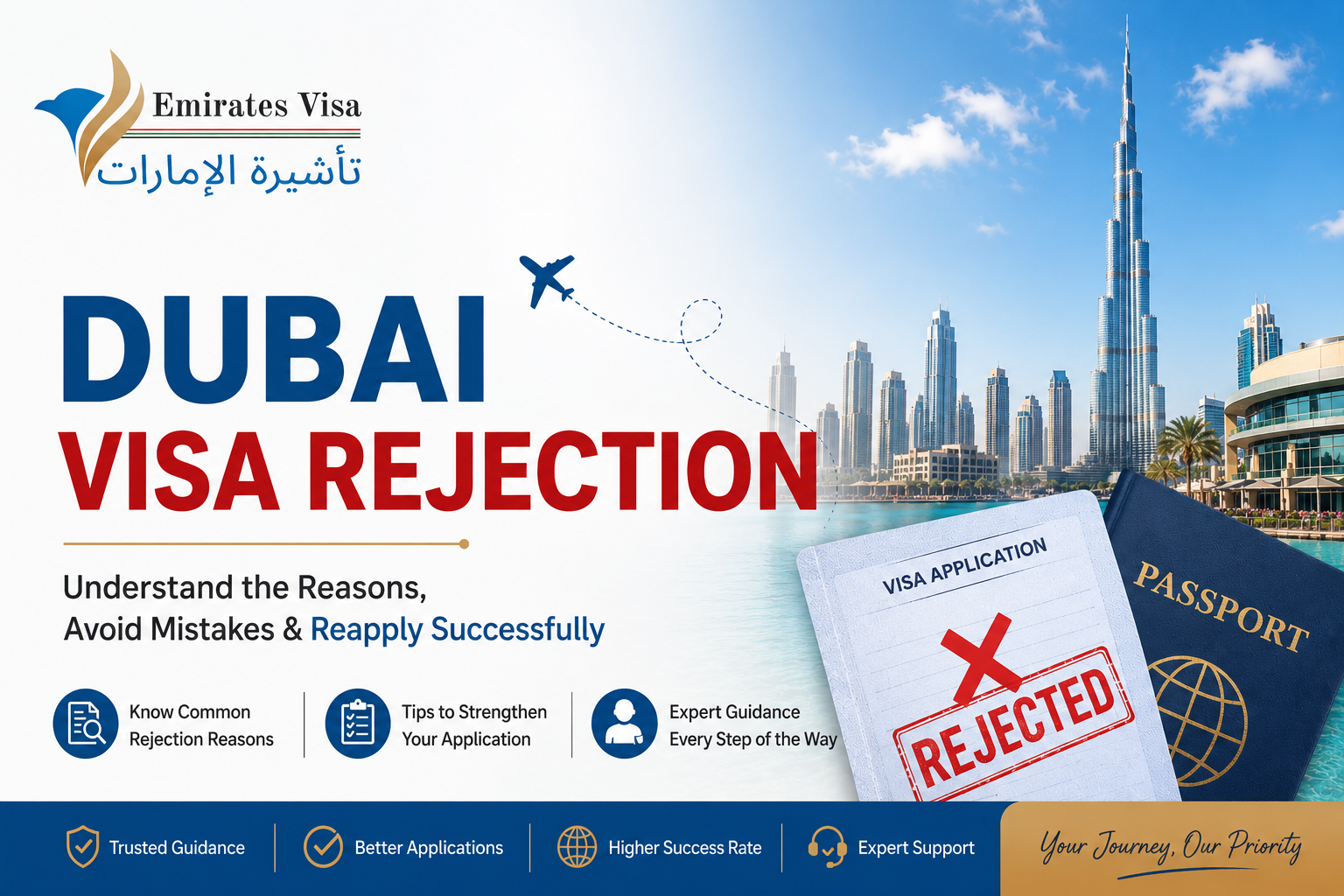
A Dubai visa rejection is one of the most stressful travel setbacks you can face. You have made bookings, arranged leave from work, told your family — and then the status changes to Rejected. It feels final. It is not.
The truth is that the vast majority of Emirates visa rejections in 2026 are caused by completely fixable issues — a small data mismatch, a blurred passport scan, an old UAE visa record that was never formally closed, or a bank statement that did not meet the required format. These are not permanent barriers. They are correctable mistakes.
This guide explains every reason why Dubai visas get rejected in 2026, how to identify your specific rejection reason, how to appeal through official UAE immigration channels, and the exact step-by-step process to reapply and get approved. By the end, you will know precisely what went wrong and exactly what to do next.
What Is a Dubai Visa Rejection?
A Dubai visa rejection means the UAE immigration authority has reviewed your application and determined it does not meet current requirements for approval. It is a formal decision — not a glitch, not a delay. The application has been processed and declined.
Visa rejections are handled by two primary UAE government authorities. The Federal Authority for Identity, Citizenship, Customs and Port Security — known as ICA — processes applications through the ICP Smart Services portal at smartservices.icp.gov.ae. The General Directorate of Residency and Foreigners Affairs — Dubai, known as GDRFA Dubai — handles Dubai-specific permits and is accessible at gdrfad.gov.ae.
It is important to understand the difference between a rejection and a ban. A visa rejection means your application did not meet requirements and you must fix the issue and reapply. A travel ban is a formal enforcement measure issued only in serious legal or immigration violation cases — and it is explicitly communicated to the applicant. Most rejections are procedural, not punitive, and the majority of applicants who correctly fix their specific issue are approved on reapplication.
View Sample Dubai Visa Rejection Letter PDF
How the UAE Immigration Screening System Works
Understanding how Dubai immigration screens applications explains why even small errors lead to rejection. The system works in multiple layers, and a flag at any single layer results in a declined application.
Layer 1 — Automated Data Verification
Every application is first checked by an automated system that compares your form data against ICA databases, verifies your name against UAE and regional watchlists, and reviews your previous UAE visa history including open permits, overstay records, and unpaid fines. At this stage, even a single typo in a passport number or a name formatted differently from your passport can trigger an automatic rejection.
Layer 2 — Document Quality Screening
Scanned documents are checked for legibility and completeness. A bio-data page where the machine-readable zone at the bottom is cropped or blurred, a photo that does not meet UAE specifications, or any document where ink has faded or pages are missing will fail at this layer. The system can reject the application without providing a specific stated reason.
Layer 3 — Financial and Intent Verification
The system assesses whether you have demonstrated sufficient funds for your stay and a credible intention to return to your home country. Bank statements, employer letters, return flight tickets, hotel bookings, and family or property ties are all evaluated at this layer.
Layer 4 — Security Screening
All applications are cross-referenced against UAE immigration databases, GCC regional watchlists, and international security registries. Applications flagged here require human review, take significantly longer, and sometimes result in rejection without a stated reason.
Key insight: Most rejections occur at Layers 1 and 2 — automated checks that flag data mismatches and document quality issues. These are the easiest to fix and the fastest to resolve on reapplication.
The 12 Most Common Dubai Visa Rejection Reasons
The reasons below are ranked by frequency of occurrence based on UAE immigration patterns in 2026 and 2026. Each reason includes the exact fix required before reapplication.
Reason 1 — Document Errors and Data Mismatches
This is the single leading cause of Emirates visa rejection in 2026. Even small inconsistencies between your application form and your passport — a different spelling of a middle name, a hyphen present in the passport but missing on the form, a date of birth entered in the wrong format, or your first and last name entered in the wrong order — trigger automatic rejection at Layer 1 screening. The UAE immigration system requires exact character-for-character matches between the application and the passport bio-data page.
Fix: Copy every field directly from your passport exactly as printed, including punctuation, spacing, and the exact order of names. Do not abbreviate any name. If your name appears differently across different documents, include a supporting legal declaration explaining the variation.
Reason 2 — Unclear, Blurred, or Incomplete Document Scans
The ICP Smart Services and GDRFA systems run automated legibility checks on every uploaded document. A bio-data page where the machine-readable zone at the bottom is cropped or blurred, a passport photo that is partially obscured, a document where ink has faded, or any page where the edges are cut off will fail this check and cause rejection — often without an explicit reason being given.
Fix: Scan all documents at a minimum of 300 DPI in full colour. Ensure the entire bio-data page is captured, including both lines of text at the very bottom of the page. Do not photograph documents with a phone camera unless the image quality is equivalent to a scanner. Upload in the format specified by the portal — usually PDF or JPEG.
Reason 3 — Passport Validity Below 6 Months
The UAE requires that your passport remains valid for at least 6 months from your intended date of arrival — not from your application date. Applications are frequently rejected when the passport expires within 6 months of the travel date even if the applicant did not notice. Damaged passports with torn pages, heavy water staining, or a degraded photo page are also rejected. Handwritten passports are automatically rejected without exception.
Fix: Check the expiry date on your passport before applying. If it expires within 6 months of your travel date, renew the passport first. Ensure you hold a machine-readable, biometric passport.
Reason 4 — Previous UAE Visa Record Not Cancelled
If you hold a previous UAE entry permit, visit visa, or residency visa that was issued but never formally cancelled in the ICA system, your new application will trigger an automatic conflict flag. This includes old employer-sponsored residency visas where the employer failed to cancel after you left the country, hotel-sponsored permits where cancellation was not processed, and self-sponsored visit visas that expired without formal closure.
Fix: Check your UAE visa status at smartservices.icp.gov.ae before applying. If any previous permit shows as Active, Issued, or Expired-Open, cancel it first through the ICP Smart Services portal. Cancellation is free online and takes under 15 minutes. See our guide on cancelling a Dubai entry permit for the exact steps.
Reason 5 — Insufficient Financial Proof
UAE immigration requires evidence that you can fully fund your stay without resorting to illegal work or requiring emergency repatriation. Common financial rejection triggers include a bank balance too low for the intended stay duration, statements older than 3 months at the time of application, unusually large deposits made immediately before applying — which immigration flags as temporarily borrowed funds — and statements without an official bank stamp or letterhead.
Fix: Submit bank statements covering the last 3 to 6 months showing a consistent and verifiable balance. Include additional financial evidence where possible — salary slips, an employment letter confirming your salary and position, or proof of property or business ownership.
Reason 6 — Wrong Visa Type Selected
Applying for a tourist visa when the actual purpose of travel is business meetings, or applying for a visit visa when an employment visa is required, is a silent but very common rejection trigger. The system cross-references your stated purpose of visit with the supporting documents you submit. A hotel-only booking submitted with an application citing a family visit, or a corporate invitation letter submitted with a tourist visa application, creates an intent inconsistency that flags the application for rejection.
Fix: Select the visa type that precisely matches your primary purpose of travel. If your trip combines tourism and a brief business meeting, choose the category that aligns with the main purpose and disclose the secondary activity in a supporting cover letter.
Reason 7 — Previous Overstay in the UAE
Any previous overstay in the UAE — including cases where your entry permit was activated at the immigration counter but was never formally cancelled on departure, causing the system to calculate an overstay even if you had physically left the country — creates a compliance record that surfaces on every future visa application. Outstanding overstay fines also block new applications from being processed.
Fix: Clear all outstanding overstay fines through the official GDRFA Dubai portal at gdrfad.gov.ae or at an approved Amer typing centre. Obtain a written clearance certificate once fines are paid. Cancel any open visa records before reapplying. See our guide on Dubai overstay fines and penalties for exact AED amounts and the full payment process.
Reason 8 — Criminal Record or Previous Deportation
The UAE maintains comprehensive records of all previous deportations and criminal convictions within the country. Gulf Cooperation Council immigration authorities also share blacklists across all member states. Any criminal offence in the UAE — including matters that are civil in other countries but criminal under UAE law, such as bounced cheques or public behaviour violations — results in automatic rejection and potentially a formal entry ban.
Fix: There is no self-service resolution for criminal record rejections. Engage a UAE-licensed immigration lawyer. In some cases, a formal legal clearance petition can be submitted to the Federal Authority for Identity, Citizenship, Customs and Port Security (ICA).
Reason 9 — Security Flag Due to Name Match or Travel History
Automated screening checks all application data against UAE immigration databases, GCC regional watchlists, and international security registries. Applications are flagged when a name partially matches any watchlist entry, when travel history shows unexplained patterns such as frequent very short UAE visits, or when the applicant has recently visited countries subject to enhanced security scrutiny. These rejections are sometimes issued with no stated reason at all.
Fix: If you suspect a name-match flag, contact the GDRFA Dubai helpline directly. Your sponsoring travel agency or hotel can also submit a sponsor inquiry to GDRFA on your behalf. Provide strong supplementary documentation — a detailed employment letter, proof of family relationships, return flight tickets, and a clear travel itinerary — to establish legitimate travel intent.
Reason 10 — Sponsor Document Issues
For family-sponsored, hotel-sponsored, or employer-sponsored permits, the sponsor's own documents must be fully valid at the time of application. An expired Emirates ID belonging to the sponsoring UAE resident, a hotel whose tourism licence has lapsed, or an employer whose trade licence is under renewal or suspension will cause the sponsored application to be rejected regardless of how complete and accurate the applicant's own documents are.
Fix: Before submitting, confirm that your sponsor's Emirates ID, UAE residency visa, and any relevant business licence are all current and valid. If any sponsor document is due to expire during the application processing window, renew it before submitting.
Reason 11 — Photo Does Not Meet UAE Specifications
The UAE has specific photograph requirements for all visa applications. The photo must have a plain white background, show the full face clearly, have eyes open and clearly visible, use a neutral expression, and have been taken within the last 6 months. Photos with coloured backgrounds, dark lighting, heavy shadow, glasses, or visible digital editing are rejected during the document quality screening stage.
Fix: Use a UAE-compliant passport photo — white background, full face, eyes open, neutral expression, no glasses. Many approved typing centres in Dubai offer on-site photo services that are pre-formatted to meet UAE requirements. If applying from abroad, use a professional photo service and specify UAE immigration photo standards.
Reason 12 — Duplicate Application Submitted
Submitting multiple simultaneous applications for the same visa type through different channels — for example, applying through the ICP Smart Services portal and also through a travel agency at the same time — creates a duplicate application record. The system identifies this as a potential inconsistency or fraud signal and may reject both applications.
Fix: Apply through one channel only. If you have already submitted an application and wish to change your sponsor or processing channel, contact the first channel to formally withdraw that application before submitting a new one.
Reason 13 — No Confirmed Return Flight or Hotel Reservation
This is the single most frequently overlooked rejection trigger for first-time UAE visa applicants. UAE immigration does not process applications on good faith -- it requires documented, verifiable proof that the applicant intends to return home. The two documents that establish this are a confirmed return flight booking and a confirmed accommodation reservation. Both must be present before the application passes the document assessment stage.
A confirmed return flight means a booking that carries a verifiable Passenger Name Record (PNR) reference -- the alphanumeric code generated when a real ticket is issued. A search result screenshot, a price comparison printout, a pending itinerary, or a travel agent's informal email does not meet this standard. The PNR must be searchable on the airline's own website.
A confirmed hotel reservation must show the full property name, the exact check-in and check-out dates aligned with the visa duration requested, and a booking confirmation reference number that can be independently verified. An unconfirmed Airbnb inquiry, a typed letter from a friend, or a forwarded agency email is not accepted.
Important -- visa duration and booking dates must match:
The hotel check-out date and the return flight date must both align with the visa duration applied for. A 30-day visa application with a 14-day hotel booking creates an inconsistency the system will flag.
Reason 14 — Unskilled Profession Listed in Passport
This rejection reason catches thousands of applicants from South Asia completely off guard because it has nothing to do with their documents, financial proof, or travel history. It is triggered by a single field in their passport they may never have questioned.
Passports issued in India, Pakistan, Bangladesh, Nepal, Sri Lanka, and several other countries include an occupation field in the bio-data section. When this field reads 'Labourer', 'Daily Wage Worker', 'Farmer', 'Housewife', or any other designation classified as unskilled by UAE immigration screening criteria, the application is automatically flagged for heightened scrutiny. In many cases the automated system declines the application before any human officer reviews the file.
This happens because UAE immigration policy tightly controls the entry of unskilled workers through the tourist and visit visa route. Applications from profession categories associated with labour migration patterns are assessed with significantly stricter criteria than applications from salaried, professional, or business-owner profiles.
Most commonly affected nationalities:
Indian, Pakistani, Bangladeshi, and Nepali passport holders are most frequently affected. The occupation field on passports from these countries is reviewed by UAE automated systems during the Layer 1 screening stage.
Reason 15 — No Evidence of Intent to Return Home
Every UAE visa application is assessed against one core question that is never explicitly stated on the form: does this person have a genuine, documented reason to leave the UAE when their visa expires? This is not a philosophical question -- it is a concrete risk assessment, and the answer has to be demonstrated with documents, not assumed.
Applications with no indicators of meaningful ties to the applicant's home country are assessed as elevated overstay risk profiles. An applicant with no stable employment record, no property ownership, no dependants, no fixed residential address, and no financial obligations at home is -- from an immigration screening perspective -- someone with very little drawing them back after their visit. This pattern triggers heightened scrutiny and, in borderline cases, outright rejection.
The rejection does not always carry an explicit reason code citing 'insufficient ties'. More often it surfaces as a generic document issue flag or a silent decline with no reason stated. The root cause, however, is the same: the application did not demonstrate a credible connection to a home country the applicant would be expected to return to.
Dubai Visa Rejection by Visa Type
Not all rejections happen for the same reasons. The most common rejection triggers vary significantly depending on which visa category you applied for.
Tourist and visit visas (30, 60, and 90 days) are most commonly rejected due to document errors, data mismatches, unclear scans, uncancelled previous permits, insufficient bank statements, and unclear travel intent. These are almost always fixable and reapplication can usually be submitted quickly after corrections are made.
Transit visas are frequently rejected due to the wrong visa type being selected, passport validity below 6 months, or the onward flight ticket details not matching the visa duration requested.
Family-sponsored permits are often rejected because the sponsor's Emirates ID or UAE residency visa has expired, or because proof of the family relationship was not included or was insufficient.
Employment and work visas are most commonly rejected due to an uncancelled previous residency or work permit, a medical fitness test failure, a profession code mismatch between the application and the passport, or an issue with the employer's trade licence or MOHRE registration.
Long-term and Golden Visas are rejected primarily due to incomplete or unattested financial investment proof, unverified property ownership documents, or educational qualifications that have not been officially attested for UAE submission.
Dubai Visa Rejection Letter PDF — What It Looks Like and What to Do With It
UAE immigration does not always issue a formal rejection letter. Most rejections appear as a status change on the ICP Smart Services portal or GDRFA Dubai portal from Processing to Rejected, sometimes with a reason code, sometimes without.
When a downloadable document is issued, a Dubai visa rejection letter PDF typically contains:
- Your application reference number and passport number
- Visa type applied for
- Decision: Rejected
- Rejection reason code where applicable (Document Incomplete, Insufficient Financial Proof, Security Review Required)
- Issuing authority — ICA or GDRFA Dubai
What to do with it: The rejection letter is your starting point for reapplication. The reason code tells you exactly what to fix. If no reason is stated, check both portals using your passport number for additional detail. Share the PDF with your visa agent so they can resolve the specific trigger before resubmitting.
Want to see exactly what a UAE rejection decision looks like? Check the Dubai visa rejection letter PDF sample below to understand the format, the fields, and how to read the reason code against your own case.
How to Check Your Dubai Visa Rejection Status
Before you do anything else, confirm the exact reason for your rejection. Acting on an assumed reason is one of the most common mistakes applicants make, and it leads directly to repeat rejection.
ICP Smart Services Portal
Visit smartservices.icp.gov.ae, select Check Application Status, and enter your application reference number and passport number. The portal displays the current decision and, where available, a rejection reason or code.
GDRFA Dubai Portal
Visit gdrfad.gov.ae and use the visa status check tool. Enter your permit number and passport details. This is the most relevant portal for Dubai-specific permits issued through GDRFA Dubai.
Emirates Visa Website
You can also check your Dubai visa rejection status directly on the Emirates Visa website by entering your application ID in the Emirates visa status tracking section.
⚠ Important: Do not reapply before checking and understanding the exact rejection reason. Reapplying without correcting the trigger often leads to repeat rejection — and multiple rejections in the system increase scrutiny on all future applications.
Are Visa Fees Refunded After Rejection?
This is one of the most frequently asked questions after a rejection. The answer, under UAE immigration policy, is no. Visa application fees are non-refundable regardless of the outcome. This applies to both the government application fee and the e-services platform levy.
Agency or typing centre service fees may be partially refundable depending on the terms of the service agreement you signed with that specific agency. If the rejection was caused by an error made by the agency on your behalf — for example, incorrect data entered during submission — you may have grounds to request a refund of the service portion from the agency directly.
Always review the terms and conditions of your visa processing agency before applying, particularly the clauses relating to rejection and refund policy.
How to Appeal a Dubai Visa Rejection
Whether a formal appeal is available depends entirely on the type of visa you applied for.
Tourist and Short-Term Visit Visas
Tourist and short-term visit visas do not have a formal statutory appeal mechanism under UAE immigration law. For these categories, the recommended and fastest route is to identify the exact rejection reason, correct it, and submit a fresh application. A corrected reapplication is treated as a new submission and is not penalised for the previous rejection, provided the reason has been genuinely addressed.
Employment, Residency, and Long-Term Visas
Employment, residency, and long-term visas do have a formal reconsideration process. You can submit a reconsideration request through the GDRFA Dubai portal at gdrfad.gov.ae or through an authorised Amer typing centre. The GDRFA appeal process typically takes 7 to 15 working days depending on case complexity.
If GDRFA Declines the Reconsideration
If the GDRFA declines your reconsideration and you believe the rejection was incorrect, judicial review can be sought under the UAE Civil Procedure Code. This requires engaging a UAE-licensed immigration lawyer and is appropriate only where there is a strong legal basis for the challenge.
How to Reapply After Emirates Visa Rejection — Step by Step
For most applicants — particularly those applying for tourist and visit visas — reapplication after fixing the rejection reason is the fastest and most effective path to approval. If you are unsure why your visa was rejected, Emirates Visa Process can help review your application, check possible issues, and guide you with a stronger reapplication.
Step 1. Identify the exact rejection reason.
Check your visa status and rejection details carefully before applying again. Do not guess. The rejection may be due to a document mismatch, unclear passport scan, previous UAE visa issue, weak financial proof, sponsor problem, or incorrect application details. You can also contact Emirates Visa for guidance in reviewing the possible rejection reason before resubmission.
Step 2. Resolve the specific issue completely.
If the rejection was due to a data mismatch, correct every field exactly as per your passport. If it was due to an uncancelled previous visa, complete the cancellation process before proceeding. If it was due to insufficient financial proof, prepare updated bank statements with a clear and consistent balance. Partial fixes can lead to repeat rejection, so the issue must be resolved properly before reapplying.
Step 3. Allow a short waiting period where needed.
For minor documentation errors, you can reapply once the correction is ready. For issues involving security checks, overstay clearance, old visa cancellation, or sponsor-related matters, wait until the issue is fully resolved. Reapplying too quickly without fixing the root cause may result in another rejection.
Step 4. Prepare a clean, complete application package.
Go through every required document again from the beginning. Do not reuse the same documents from the previous application without checking them properly. Make sure your passport is valid for at least 6 months from the intended arrival date, all scans are clear, bank statements are updated if required, accommodation proof is valid, return flight details are available, and sponsor documents are complete where applicable.
Step 5. Reapply through EmiratesVisa.in.
Once your documents are corrected and ready, you can reapply online through Emirates Visa. The team can help you choose the right visa type, review your documents, check application details, and guide you through the submission process. Applying through one proper channel helps avoid duplicate applications, repeated mistakes, and unnecessary processing delays.
Step 6. Save all confirmation receipts.
After submission, save your application reference number, payment confirmation, and submission details. These records are important for tracking your application status, following up with support, and checking the final visa status.
Step 7. Track your application until approval.
After reapplying, monitor your visa status carefully. If additional documents are requested, submit them quickly and accurately. Once approved, download your Emirates visa, check all details, and keep both printed and digital copies before travelling.
Pre-Application Checklist to Avoid Rejection
Use this checklist before submitting any Dubai visa application in 2026. Completing every item before submission dramatically reduces rejection risk.
Passport Checks
- Passport is machine-readable and biometric — no handwritten passports
- Passport is valid for at least 6 months beyond your intended arrival date in the UAE
- Passport has at least two blank visa pages
- Passport has no damage — no torn pages, no water stains, no faded photo
Data Accuracy Checks
- Full name on the application matches the passport exactly, including middle names and punctuation
- Date of birth is entered in the correct format as shown on the passport
- Passport number is entered exactly as printed, with no spaces or missing characters
- Nationality matches the passport issuing country exactly
Document Scan Checks
- All pages are scanned at 300 DPI or higher in full colour
- The machine-readable zone at the bottom of the bio-data page is fully visible and legible
- No pages are cropped, rotated, or shadowed
- Documents are uploaded in the format required by the portal
Previous UAE Record Checks
- Checked ICP Smart Services portal and confirmed no open or uncancelled previous UAE permits
- Confirmed no outstanding overstay fines or unpaid immigration penalties
- Confirmed sponsor's Emirates ID, residency visa, and trade licence are all current
Financial Proof Checks
- Bank statements cover the last 3 to 6 months
- Statements carry an official bank stamp or are downloaded from the official bank portal
- Balance is consistent and sufficient for the duration of the intended stay
- No unusually large recent deposits that could appear as borrowed funds
Supporting Document Checks
- Return flight ticket is confirmed and dates match the visa duration requested
- Hotel booking or host details are confirmed and dates are consistent
- For family visits, proof of the UAE resident's Emirates ID and proof of relationship are included
- Photo meets UAE specifications — white background, full face, eyes open, neutral expression, taken within the last 6 months
Need Help After a Dubai Visa Rejection?
Our UAE visa experts can review your rejection reason, prepare a corrected application, and manage the full reapplication process for you — same-day turnaround available for urgent cases. Whether your rejection involves a corporate sponsor, a security flag, a lost permit number, or a disputed record, we resolve it correctly from start to finish.
Dubai Visa Rejected?
Re-Apply Your Dubai Visa
With Expert Assistance
Our UAE visa specialists review your rejection reason, correct application errors, and help you submit a stronger visa application with better approval chances.
10,000+ Approved Free Visa Review Fast Support
Re-Apply Now Talk to Expert

 TOURIST VISA