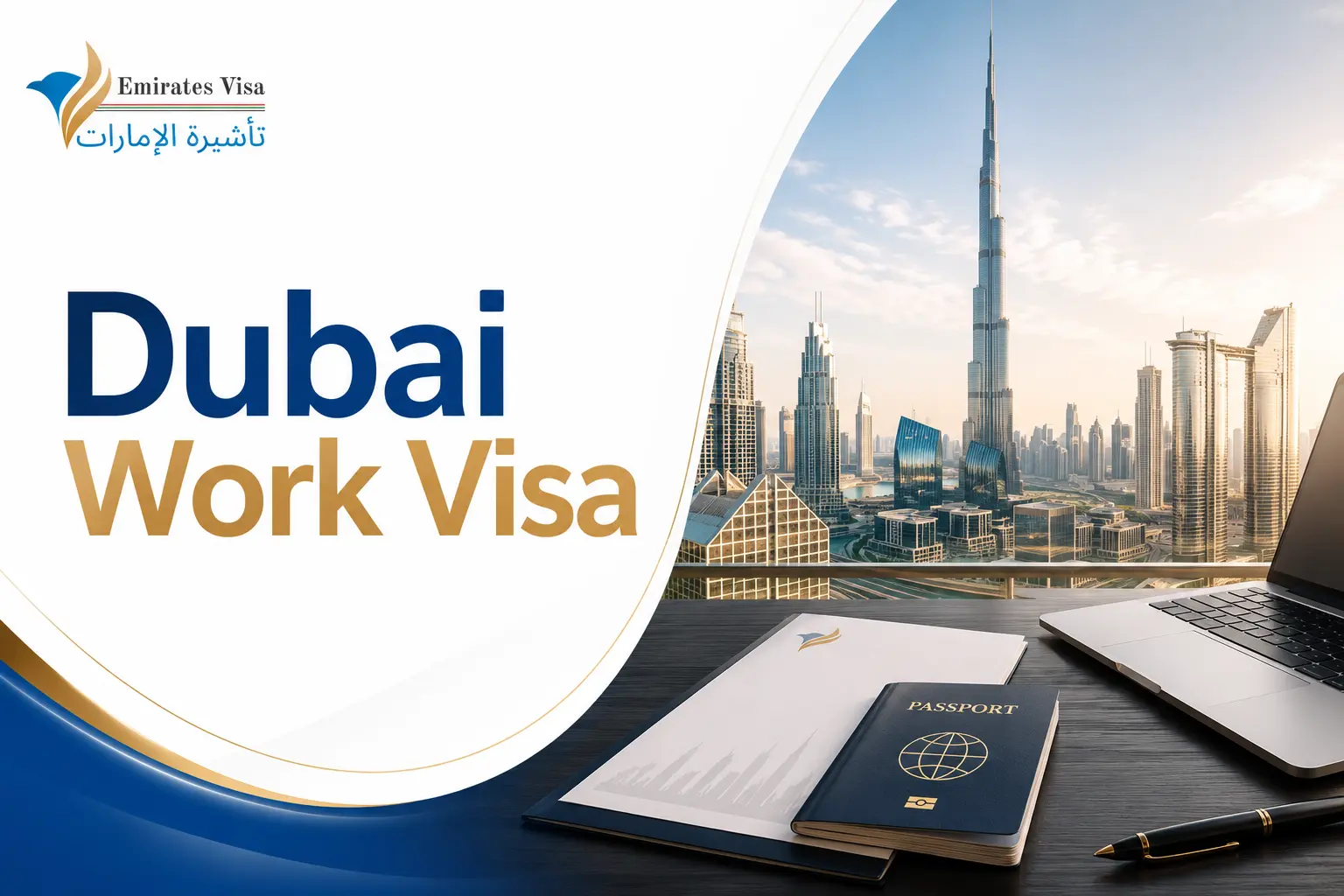
If you have received a job offer in Dubai — or are planning to work in the UAE — securing a Dubai Work Visa is your first and most important step. Dubai is one of the world's most desirable destinations for skilled professionals, offering competitive salaries, zero personal income tax, a high standard of living, and an ever-growing job market across industries like technology, finance, healthcare, construction, hospitality, and more.
However, working in Dubai without the proper work authorization is illegal under UAE labour law. Every foreign national who wishes to work in Dubai must hold a valid Dubai employment visa (also called a UAE work visa or Dubai residence visa for employment) issued under the sponsorship of a registered UAE employer.
This comprehensive guide covers everything you need to know: who qualifies, what documents you need, how the application process works, how much it costs, how long it takes, and what rules you must follow once your visa is approved.
Quick answer: A Dubai Work Visa is an employer-sponsored UAE residence visa that allows a foreign employee to legally live and work in Dubai. The process usually includes MOHRE work permit approval, entry permit issuance, medical fitness testing, Emirates ID registration, health insurance, and residence visa processing through GDRFA Dubai or ICP Smart Services.
What Is a Dubai Work Visa?
A Dubai Work Visa is an official authorization that allows a foreign national to legally enter, reside, and work in Dubai (and the wider UAE) under the sponsorship of a UAE-registered employer. It is not a single document — rather, it is a combination of several government-issued approvals and documents that together grant an employee the right to work and live in Dubai.
The key components of a Dubai Work Visa typically include:
- MOHRE Labour Approval (Work Permit) — issued by the Ministry of Human Resources and Emiratisation
- Entry Permit — allows the employee to enter the UAE for visa stamping
- Residence visa approval — digital residence permit, linked with Emirates ID and immigration records.
- Emirates ID — national identity card issued to all UAE residents
Together, these documents are what most people refer to as the Dubai Work Visa or Dubai employment visa. In free zones, the process is managed by the respective free zone authority rather than MOHRE, though the residence visa is still issued by GDRFA or ICP.
Who Needs a Dubai Work Visa?
Any foreign national who intends to work in Dubai — whether in the private sector, government-linked entities, or a free zone — must hold a valid work visa. This includes:
- Professionals relocating to Dubai with a confirmed job offer
- Skilled workers, technicians, and blue-collar employees
- Senior executives, managers, and specialists
- Employees transferring within a multinational company to a Dubai office
- Remote workers employed by UAE-based companies
UAE citizens and GCC nationals (citizens of Saudi Arabia, Qatar, Kuwait, Bahrain, and Oman) are exempt from needing a work visa and can work freely across member states.
Dubai Work Visa Eligibility Criteria
To be eligible for a Dubai Work Visa, both the employer and the employee must meet certain conditions set by UAE authorities.
For the Employee:
- Must have a valid job offer from a UAE-registered company or free zone entity
- Passport must be valid for at least 6 months from the date of application
- Must pass a UAE medical fitness test (certain communicable diseases result in disqualification)
- Educational qualifications must be relevant to the job role and, where required, officially attested
- Must not be banned or blacklisted from previous UAE employment
- Must not have overstayed a previous UAE visa without proper resolution
For the Employer:
- Must be a legally registered company under UAE mainland law or a recognised free zone
- Must hold a valid trade licence and MOHRE registration (for mainland companies)
- Must comply with UAE Emiratisation quotas and labour compliance requirements
- Must provide mandatory health insurance to the employee before visa stamping
Required Documents Checklist
The exact document list can vary slightly depending on the emirate, industry, free zone, or employee profile. However, the following is a standard checklist used across most Dubai work visa applications:
| Document | Details / Notes |
|---|
| Passport | Valid for at least 6 months; clear copy required |
| Personal Photograph | Recent passport-size photograph with a white background |
| Educational Certificates | Certificates must be attested by the relevant authorities |
| Employment Contract | Signed offer letter or employment contract from the UAE employer |
| Medical Fitness Certificate | Issued by a UAE-approved health centre |
| Emirates ID Application | Biometrics and registration are completed through ICP |
| Health Insurance Card | Provided by the employer before visa stamping |
| MOHRE Labour Approval | Work permit issued by the Ministry of Human Resources |
| Entry Permit | Pre-entry document required for overseas applicants |
| Visa Stamping Page | Passport stamped by GDRFA or ICP after entry |
Note: Documents issued outside the UAE (such as educational certificates or police clearance certificates) may need to be attested by the UAE embassy in the country of origin and then by the UAE Ministry of Foreign Affairs.
Step-by-Step Dubai Work Visa Application Process
The Dubai work visa process generally follows these stages. The exact steps may vary depending on whether the employer is a mainland company or a free zone entity.
Step 1: Job Offer and Employment Contract
The process begins when an employer extends a formal job offer and the employee signs an employment contract. This contract must align with UAE labour law standards and be registered with MOHRE (for mainland jobs).
Step 2: MOHRE Labour Approval (Work Permit)
The employer submits a work permit application to the Ministry of Human Resources and Emiratisation. MOHRE reviews the employer's eligibility, the employee's qualifications, and the job role before granting a labour approval.
Step 3: Entry Permit Issuance
Once the labour approval is granted, the employer applies for an Entry Permit through GDRFA Dubai or ICP Smart Services (depending on the emirate). This permit allows the employee to enter the UAE for the purpose of visa residency stamping.
Step 4: Employee Enters the UAE
If the employee is outside the UAE, they travel on the Entry Permit. Employees already inside the UAE on a visit or tourist visa may need to exit and re-enter, or apply for a status change in some cases.
Step 5: Medical Fitness Test
Within a set number of days of entering the UAE, the employee must complete a medical fitness test at an approved UAE health centre. This typically includes blood tests and a chest X-ray. Applicants with certain communicable diseases are not eligible for a UAE work residence visa.
Step 6: Emirates ID Application
The employee registers for an Emirates ID through ICP Smart Services. Biometric data (fingerprints and photo) is collected at an authorised typing centre or ICP service centre.
Step 7: Residence Visa Stamping
After passing the medical test and completing the Emirates ID process, the residence visa is stamped in the employee's passport. This is handled by GDRFA Dubai or ICP and formally completes the Dubai Work Visa process.
Step 8: Health Insurance Activation
Employers in Dubai are legally required to provide health insurance coverage to their employees. The health insurance card should ideally be provided before or at the time of visa stamping.
Dubai Work Visa Cost: Full AED Fee Breakdown
The table below gives a component-by-component breakdown of government fees payable in 2026. All costs are borne by the employer under Federal Decree-Law No. 33 of 2021 — employees should not be asked to fund their own work visa.
Dubai Work Visa — Component Cost Breakdown (AED, 2026)
| Fee Component | Approx. Cost (AED, 2026) | Who Pays | Notes |
|---|
| MOHRE work permit (labour card) | AED 250 – AED 5,000 | Employer | Cost depends on company's MOHRE Category (1/2/3) and employee skill classification |
| Employment entry permit | AED 1,100 – AED 1,200 | Employer | Issued by GDRFA / ICP; valid 60 days; allows employee to enter UAE for visa stamping |
| In-country status change | AED 650 – AED 1,200 | Employer | Alternative to entry permit when employee is already inside the UAE on another visa |
| Medical fitness test | AED 320 – AED 500 (standard)
AED 500 – AED 800 (same-day express) | Employer | DHA-approved health centres; mandatory at each application and renewal cycle |
| Emirates ID (2-year) | approx. AED 370 | Employer / Sponsor | Includes base fee + knowledge dirham + innovation dirham charges |
| Health insurance (annual) | AED 700 – AED 2,500+ | Employer | Mandatory; premium varies by plan, provider, and employee age / medical history |
| Typing centre / PRO fees | AED 300 – AED 800 | Employer | Administrative processing; varies by service provider |
| GDRFA / ICP residency stamping | AED 200 – AED 400 | Employer | Final residence visa stamp in passport |
| Fast-track / express processing | AED 500 – AED 1,000 (additional) | Employer | Optional; reduces total timeline from 15–25 working days to approx. 5–7 working days |
Typical total range: AED 3,500 – AED 12,000 for a standard 2-year mainland employment visa, depending on company MOHRE category, employee skill level, insurance plan, and whether fast-track processing is used.
Note: These are indicative figures sourced from MOHRE, GDRFA, and ICP published schedules. Government fees are subject to change without notice. Always confirm current fees with your PRO, typing centre, or a registered visa consultancy before initiating the process.
Factors That Affect the Total Cost:
- Employer type: Mainland company vs. free zone entity (free zones often have bundled visa packages)
- Job category and skill level: Professional, skilled, or unskilled classifications can affect government fee tiers
- Medical fitness test: Fees vary by health centre and can include additional charges for specific tests
- Emirates ID fees: Issued by ICP and based on visa duration
- Health insurance: Premiums vary by plan and provider
- Typing centre and PRO service fees: Administrative charges for document processing
- MOHRE work permit fee: Varies based on employer classification and quota compliance
- GDRFA / ICP entry permit and residency stamping fees: Standard government charges
In most cases, the employer bears the cost of the Dubai Work Visa as required under UAE labour law. Employees should not typically be asked to pay for their own visa processing by their employer. If you are being asked to pay these costs directly, it is advisable to verify this arrangement with a legal or HR professional familiar with UAE employment regulations.
For a personalised cost estimate based on your specific situation, we recommend reaching out to a registered visa consultancy or your employer's PRO (Public Relations Officer).
How MOHRE Company Category Affects Your Work Visa Cost
One of the most important — and most overlooked — cost factors is your employer's MOHRE classification. MOHRE assigns every UAE-registered mainland company one of three categories based on Emiratisation compliance, wage payment history (WPS), and workplace safety records.
| MOHRE Category | Compliance Level | Approx. Work Permit Fee | Key Criteria |
|---|
| Category 1 | Highest compliance | AED ~250 – AED 300 per work permit | Best Emiratisation record, no outstanding MOHRE violations, full WPS compliance |
| Category 2 | Mid-tier compliance | AED ~1,000 – AED 2,000 per work permit | Moderate Emiratisation rate; some outstanding issues possible |
| Category 3 | Lowest compliance | AED ~3,000 – AED 5,000 per work permit | Low Emiratisation compliance or outstanding labour violations; highest fees |
Category 1 employers pay the lowest work permit fees and face fewer processing delays. Category 3 employers not only pay significantly higher fees but may also face restrictions on visa quota and processing timelines. Employees accepting a job offer can ask their employer which category they hold — it directly affects how quickly and how cost-effectively the visa can be processed.
Tip: If you are an employer applying for your first employee visa, check your MOHRE category status via the Tas'heel portal (tasheel.mohre.gov.ae) before calculating your budget.
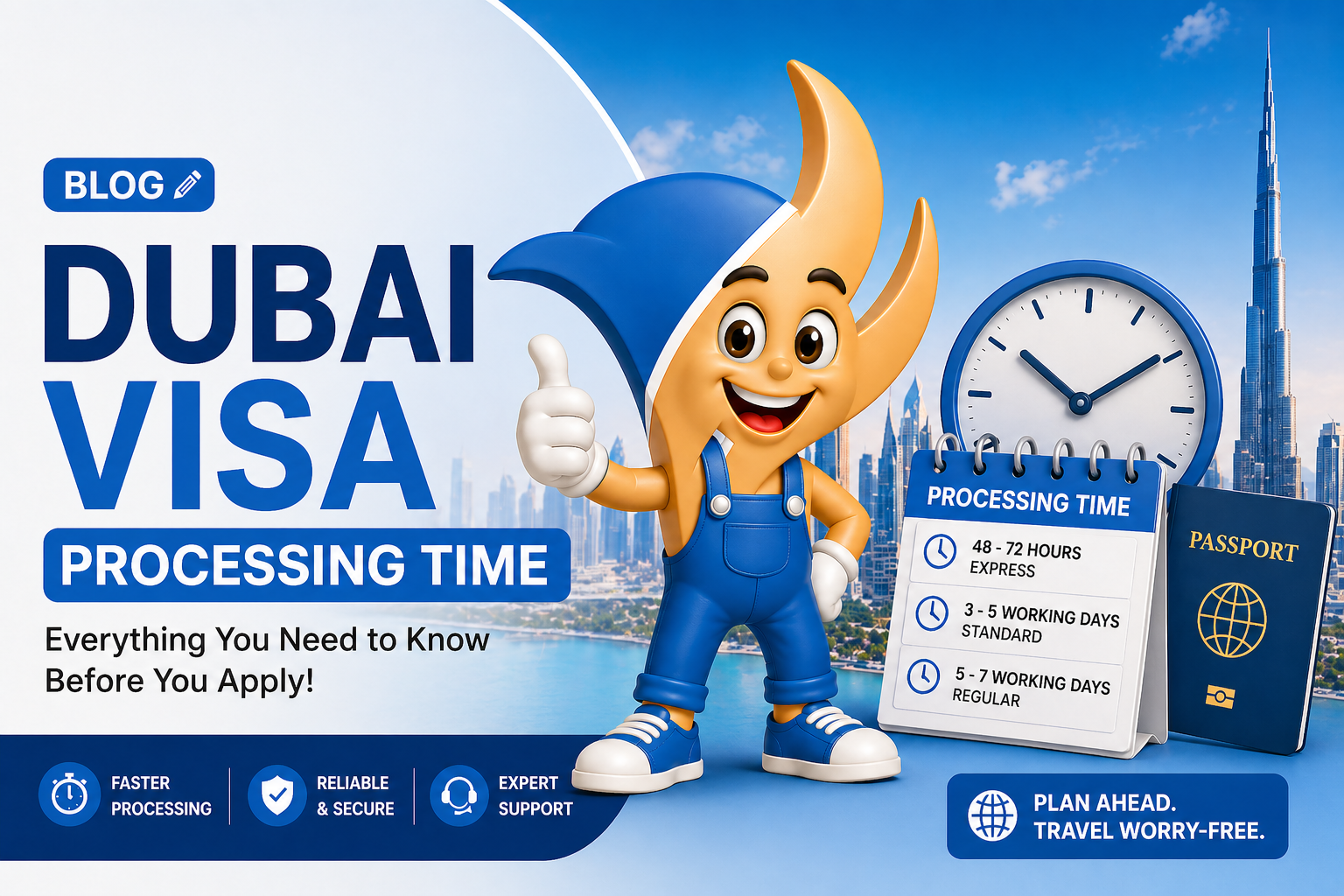
Dubai Work Visa Processing Time
Processing time for a Dubai Work Visa depends on which stage of the process is being measured and external factors such as application volume, document accuracy, and government processing queues.
- MOHRE Labour Approval: 3–7 working days (routine applications)
- Entry Permit: 2–5 working days after MOHRE approval
- Medical Fitness Test: Same-day or 1–2 days for results
- Emirates ID Registration: Application is same day; card is typically delivered within 5–7 working days
- Residence Visa Stamping: 2–5 working days after medical clearance
From start to finish, the average Dubai Work Visa process takes approximately 15–25 working days for a straightforward case. Complex applications, incomplete documents, or high applicant volumes during peak seasons can extend this timeline.
Fast-Track Processing Option
For time-sensitive cases, express or fast-track processing is available at an additional cost of approximately AED 500 – AED 1,000. This can reduce the total visa processing time from the standard 15–25 working days to approximately 5–7 working days. Fast-track is arranged through the employer's PRO or typing centre and is subject to government approval and processing queue availability at the time of application.
Note: Fast-track availability and fees vary by government service centre and may not be available during peak application periods. Confirm availability with your PRO before committing to a fast-track timeline.
Can I Sponsor My Family on a Dubai Work Visa?
Yes. Holders of a valid Dubai employment visa (residence visa) are eligible to sponsor their immediate family members as dependents, subject to meeting the minimum salary threshold and providing the required documentation.
Minimum Salary Requirement for Family Sponsorship
To sponsor a spouse and children in Dubai, the employment visa holder generally needs to earn a minimum monthly salary of AED 4,000 or more (or AED 3,000 plus employer-provided accommodation). This threshold is set by UAE immigration authorities and is subject to review.
⚠ Note: Salary thresholds for family sponsorship may be updated by GDRFA or ICP. Always verify the current minimum with your PRO or directly at icp.gov.ae before applying for dependent visas.
Who Can You Sponsor and What Documents Are Required?
| Dependent | Key Documents Required | Notes / Conditions |
|---|
| Spouse | Valid UAE employment visa + Emirates ID; minimum salary requirement met; valid marriage certificate (attested) | Salary generally AED 4,000/month or higher (AED 3,000 + accommodation in some cases) — confirm with GDRFA/ICP |
| Children (under 18) | Birth certificates (attested); sponsor's valid employment visa and Emirates ID; children's passports; health insurance for each dependent | Usually no separate salary threshold beyond the spouse sponsorship requirement — check current ICP guidelines |
| Children (18–24, in education) | University enrolment proof; valid educational institution in UAE or overseas; updated documents each academic year | Some exceptions apply — verify directly with ICP (icp.gov.ae) |
| Parents | Sponsor's valid employment visa; No Objection from employer in some cases; health insurance mandatory | Subject to eligibility criteria — not automatic; confirm with ICP before applying |
Health Insurance for Dependents
Health insurance is mandatory for all sponsored dependents in Dubai. The cost is borne by the sponsor (employment visa holder) and is separate from the employer's obligation to provide health insurance for the employee. Insurance must be active before the dependent's residence visa is stamped.
✓ Emirates Visa can provide guidance on the dependent visa process and documentation checklist once your own employment visa is approved. Contact our team for post-approval family sponsorship support.
Dubai Work Visa Validity and Renewal
Validity
A standard Dubai Work Visa (residence visa linked to employment) is typically issued for 2 years and is renewable. Some professional and investor categories may receive 3-year or 5-year visas under special programmes, but the standard employment visa runs for 2 years.
Renewal Process
Your employer initiates the renewal process before the current visa expires. It is important to begin this process at least 2–3 months before expiry to avoid overstay fines. The renewal involves:
- Renewal of the MOHRE work permit
- A new medical fitness test (required at each renewal)
- Emirates ID renewal through ICP
- Residence visa re-stamping in the passport
If the visa expires and is not renewed, the employee is technically overstaying, which can result in fines calculated per day of overstay, as well as potential immigration bans.
Visa Cancellation
When an employee leaves a job or the country permanently, the employer must cancel the work visa through MOHRE and GDRFA/ICP. After cancellation, a grace period is typically provided to either leave the country or transfer to a new visa. Employees should always request their visa cancellation document (also called a visa cancellation letter) as proof.
Grace Period After Visa Cancellation — What You Are Entitled To
When an employment visa is cancelled by an employer, the employee is entitled to a grace period before they are required to either leave the UAE, transfer to a new employer's sponsorship, or change to another valid visa status. In 2026, the grace period is generally:
During this grace period, the individual may legally remain in the UAE and seek new employment, transfer their visa under a new sponsor, or voluntarily depart. Overstaying beyond the grace period triggers the standard UAE overstay fine of AED 50 per day from day one with no additional buffer.
Note: Grace period rules are subject to revision by GDRFA and ICP. Always confirm the specific grace period applicable to your situation directly with your employer's PRO or the relevant immigration authority at the time of visa cancellation.
Dubai Work Visa vs Work Permit vs Employment Visa vs Residence Visa
These terms are often used interchangeably in everyday conversation, which creates confusion. Here is a clear breakdown:
- Work Permit (MOHRE Labour Approval): The initial government permission for an employer to hire a foreign national. It is an internal government document and not the same as the visa stamped in your passport.
- Dubai Employment Visa / UAE Work Visa: The general term referring to the entire package of authorisations that allow a foreign national to work in Dubai, including the MOHRE approval, entry permit, and residence stamp.
- Entry Permit: A temporary document allowing a foreign national to enter the UAE for the purpose of completing the residence visa process.
- Residence Visa: The actual visa stamp in the passport, conferring the right to reside in the UAE. For employment purposes, this is tied to the employer's sponsorship.
- Emirates ID: The national identity card issued to all UAE residents. It is not a visa but is a compulsory document linked to your visa status.
In summary, when someone says 'I need a Dubai Work Visa,' they are usually referring to the full employment and residence visa package — not any single document in isolation.
Employer and Employee Responsibilities
Employer Responsibilities Under UAE Labour Law:
- Bear all costs related to visa processing (unless a contractual arrangement is otherwise legally permitted)
- Provide mandatory health insurance before visa stamping
- Maintain accurate employee records with MOHRE
- Cancel the visa when employment ends
- Comply with UAE Wages Protection System (WPS) for salary payments
- Adhere to Emiratisation quotas and labour law requirements
Employee Responsibilities:
- Provide accurate, original, and attested documents as required
- Complete the medical fitness test within the required timeframe
- Register for and collect the Emirates ID
- Inform the employer immediately if passport details change
- Not work for another employer without proper NOC (No Objection Certificate) or visa transfer
- Comply with the terms of the employment contract and UAE labour law
Common Rejection Reasons and How to Avoid Them
Dubai Work Visa applications are rejected for a range of reasons. Here are the most common issues and how to prevent them:
- Failed Medical Test: Certain medical conditions disqualify applicants from receiving UAE residence visas. Ensure your health is in order and be transparent during processing.
- Incomplete or Incorrect Documents: Always double-check every document — especially name spellings — against your passport. Mismatches cause delays and rejections.
- Unattest Education Certificates: If your role requires degree verification, ensure all certificates are attested by the relevant authorities before applying.
- Previous UAE Immigration Violations: Overstays, bans, or unpaid fines from past UAE visits or employment can block new visa applications. Resolve all outstanding issues first.
- Employer Not Compliant with MOHRE: If your employer has outstanding labour violations or is blacklisted by MOHRE, visa applications will be blocked until resolved.
- Passport Validity: If your passport is due to expire within 6 months, renew it before initiating the visa process.
- Job Category Mismatch: Your employment contract and visa application must accurately reflect your actual job role. Discrepancies raise flags during MOHRE review.
Important Rules After Getting Your Dubai Work Visa
Receiving your Dubai Work Visa is just the beginning. Here are the key rules every visa holder must follow:
- Do not work for another employer unless the correct MOHRE/free-zone approval, work permit transfer, or legal authorisation has been completed.
- Keep your passport, Emirates ID, and health insurance card safe and carry them when required.
- Inform your employer if you plan to travel outside the UAE for extended periods, as some visa rules require re-entry within specific timeframes.
- Do not overstay your visa — if your visa is about to expire and renewal is delayed, notify your employer immediately.
- Follow UAE laws at all times. Criminal convictions can result in deportation and immigration bans.
- If you resign or are terminated, clarify the visa cancellation timeline with your employer and understand your grace period options.
- Keep copies of all visa documents, employment contracts, and MOHRE approvals for your own records.
Need Help with Your Dubai Visa Application?
The Dubai Work Visa process involves multiple steps, government portals, and strict documentation requirements. A single error can lead to delays or rejection — which is why many applicants choose to work with experienced visa professionals.
Whether you need help with the full application, document attestation, medical test coordination, or Emirates ID registration — our team is here to guide you every step of the way.
- Expert guidance on MOHRE approvals and entry permits
- Document checklist and attestation support
- Fast-track assistance for urgent cases
- Renewal and visa transfer services
For comprehensive Dubai Visa services and step-by-step support, explore our full range of offerings on this platform.
Dubai Work Visa Assistance
Need Help with Your Dubai Work Visa?
Applying for a Dubai Work Visa requires the right documents, employer sponsorship, MOHRE approval, medical fitness testing, Emirates ID registration, and residence visa processing.
Emirates Visa can help you understand the process, prepare your documents, and choose the right visa support based on your UAE employment situation.
Get Visa Guidance How To Apply

 TOURIST VISA