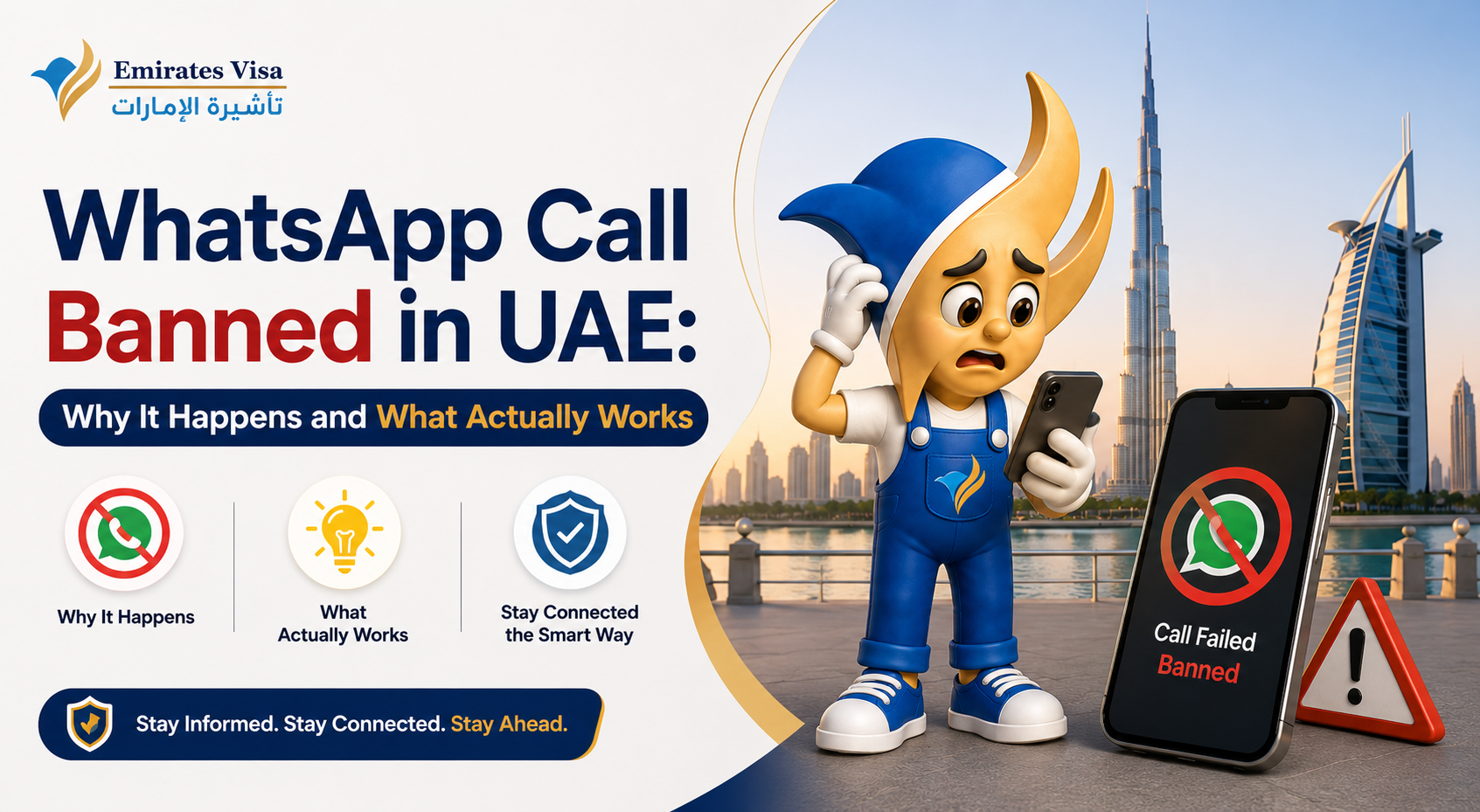
If you have just landed in Dubai, Abu Dhabi, or Sharjah and tried to call home on WhatsApp, you already know the problem: the app opens fine, the message thread loads, but the call simply will not connect. This is not a fault with your phone, your SIM, or your WhatsApp account. It is a deliberate, long-standing restriction built into how the UAE regulates internet calling — and it catches almost every first-time visitor and new resident off guard, because nothing in your visa approval, boarding pass, or hotel check-in tells you about it in advance.
This guide explains exactly why WhatsApp voice and video calls are blocked in the UAE in 2026, what is actually happening at the network level, the legal risks of trying to bypass it, and — most usefully — the calling methods that genuinely work for travellers, visa holders, and residents who need to stay in touch.
What Exactly Is Blocked, and What Still Works
The restriction is narrower than most people assume. WhatsApp itself is not banned in the UAE — you can download it, message on it, and use it daily without any issue. Only the real-time voice and video calling feature is blocked at the network level by the country's licensed telecom operators, e& (formerly Etisalat) and du.
| WhatsApp Feature | Status in UAE | Notes |
|---|
| Text messages & group chats | Works normally | No restriction |
| Photos, videos, documents | Works normally | All file types |
| Voice notes | Works normally | Recorded audio, not live |
| OTPs / visa document sharing via chat | Works normally | Relevant for visa applicants |
| Voice calls (1:1 and group) | Blocked | VoIP traffic blocked by ISPs |
| Video calls (1:1 and group) | Blocked | Same VoIP restriction |
There is no warning or error message explaining why — the call simply fails to connect, or shows “Call Failed” after a few seconds. The same block applies to FaceTime, Viber, and standard consumer Skype calls. It is not a WhatsApp-specific policy; it is a restriction on the underlying VoIP (Voice over Internet Protocol) technology, applied equally on Wi-Fi and mobile data, to residents, tourists, and business travellers alike.
Two details trip people up specifically. First, the restriction is bidirectional: it is not only that you cannot call out from a UAE network — a friend or relative calling you from outside the UAE will also have the call blocked before it reaches your device. Your phone will not ring, and you may only see a missed-call notification appear in the chat afterwards. Second, the block is not limited to the mobile app: WhatsApp Web and WhatsApp Desktop are restricted in exactly the same way. Messaging and file sharing work fine on Web and Desktop; calling does not.
Why WhatsApp Calls Are Restricted in the UAE
The ban is not arbitrary. It rests on three reinforcing pillars of UAE telecom policy, and understanding them is the fastest way to stop being frustrated by the restriction and start planning around it.
1. Telecom Licensing Law
Under the UAE's telecommunications framework, any service that carries real-time voice or video over the internet is classified as a regulated telecommunications service. Only the two licensed national operators, e& and du, and a short list of apps explicitly approved by the Telecommunications and Digital Government Regulatory Authority (TDRA), may legally offer this kind of calling inside the UAE. TDRA itself — the independent federal authority established under Federal Law by Decree No. 3 of 2003 to oversee the UAE's telecommunications sector — confirms on its official FAQs page (tdra.gov.ae/en/FAQs) that internet-based voice and video services fall under its VoIP regulatory policy. WhatsApp has not sought or received that licence for its calling feature, so ISPs are required to filter the traffic. (Verified against the TDRA portal, June 2026.)
2. National Security and Encryption
WhatsApp calls are protected by end-to-end encryption, meaning not even WhatsApp itself can access the content of a call. UAE national security policy requires that licensed communication channels remain open to lawful interception when authorities need it. An encrypted, unlicensed calling channel does not meet that requirement, which is a major reason the restriction has stayed in place even as the UAE has rapidly modernised other digital services.
3. Protecting Telecom Revenue
e& and du are the UAE's two licensed operators, and international calling has historically been a significant and steady revenue line for both. Free, unrestricted VoIP calling through global apps would compete directly with that revenue. By keeping voice and video traffic on licensed paid channels, the regulatory model protects the commercial position of the operators that built and maintain the UAE's telecom infrastructure.
These three forces reinforce each other, which is why occasional predictions of an imminent “WhatsApp calling unban” have not materialised. As of mid-2026, there has been no official TDRA announcement lifting the restriction, even as neighbouring Saudi Arabia has eased some of its own VoIP rules. The more realistic direction of travel is expanded, paid, licensed access — not a free consumer unlock.
The Legal Framework and What It Means for You
Two pieces of UAE federal legislation are relevant if you are weighing whether to try to work around the restriction.
| Law | What It Covers | Practical Risk |
|---|
| UAE Telecommunications Law | Requires a TDRA licence for any voice/video calling service | ISPs are obligated to block unlicensed VoIP traffic at the network level |
| Federal Decree-Law No. 34 of 2021 (Cybercrime Law), Article 10 | Penalises using technology to disguise an IP address to commit or conceal an offence | Fines of AED 500,000–2,000,000 and possible imprisonment for deliberate, large-scale circumvention |
In practice, an individual traveller whose WhatsApp call simply fails to connect faces no legal exposure at all — nothing has happened; the call did not go through. The legal risk only becomes real if you deliberately use a VPN specifically to bypass the VoIP block. Enforcement to date has focused on large-scale or commercial circumvention rather than individual personal calls, and first-time personal use is unlikely to be prosecuted. That said, the penalty range is severe enough that it is not a risk worth taking for the sake of a single phone call when fully legal alternatives exist.
One important clarification specific to VPN use generally: VPNs themselves are not illegal in the UAE. Businesses and individuals use them legitimately every day for secure access to corporate networks. The legal issue is narrow and specific — using a VPN with the intent to access a service the UAE has restricted.
What Actually Works: Legal Alternatives for Calling in the UAE
This is the part most articles bury at the bottom. If you need to make voice or video calls in the UAE — to family back home, to your visa agent, or for business — these are the TDRA-recognised options that work reliably, today, with no legal ambiguity.
- BOTIM: The most widely used licensed calling app in the UAE. Requires Etisalat or du's Internet Calling Plan add-on (AED 50/month, billed to your account, confirmed on Etisalat's official support page at support.etisalat.ae) to unlock calling. Works on both e& and du networks without a VPN. The person you are calling does not need to be in the UAE, but they do need the BOTIM app installed.
- GoChat: e&'s own calling app, launched in 2022 and now used by millions of e& customers. It is free to use for basic calls within the e& ecosystem, with no separate VoIP subscription required — a useful option if you or your contact are on an e& (Etisalat) SIM.
- C'Me: A third TDRA-approved calling app, lighter than BOTIM, with a simpler interface focused purely on calls.
- Zoom and Microsoft Teams: Fully approved for both personal and business video calling. The most reliable option if the people you need to reach are not willing to install a new calling app, since many already have Zoom or Teams installed.
- Travel eSIMs (for short-stay visitors): Some international eSIM data plans route traffic through an overseas network rather than the local e&/du infrastructure, which in practice avoids the local VoIP filtering for WhatsApp calls. This must be installed and active before you land, since some UAE networks restrict activating new international eSIMs once already connected locally. This is a workaround some travellers use rather than an officially sanctioned method, so treat it as a practical option, not a guaranteed or endorsed one. For cost context: a 5–7 day unlimited-data UAE travel eSIM typically runs roughly AED 75–110 (about USD 20–30), versus Etisalat's own Internet Calling Plan — the AED 50/month add-on required to activate BOTIM — which bills monthly regardless of trip length. For a stay under a week, the eSIM route is usually cheaper; for a month or longer, the BOTIM/Internet Calling Plan route works out cheaper per day.
- Standard mobile/landline calling: Often overlooked, but a local UAE SIM with an international calling package remains the most dependable fallback for short, time-sensitive calls, including any call you need to make to your visa service provider or airline.
For most visitors, the simplest setup is: install BOTIM before you travel, keep WhatsApp for messaging and document sharing (which works perfectly), and rely on Zoom or Teams for any scheduled video call with people back home.
Does This Affect Your UAE Visa Application or Communication with Authorities?
No. This is a common and reasonable concern for travellers in the middle of a visa process, so it is worth addressing directly: the WhatsApp calling restriction has no bearing on your visa application, document submission, or OTP verification. All of that happens through text-based channels — chat messages, document uploads, and SMS or email OTPs — none of which are affected by the VoIP block.
A few specific touchpoints worth knowing before you travel:
- Visa file number and status checks: Tracking your application or verifying your visa file number through GDRFA or ICP online services does not involve any calling feature, so the restriction has zero impact on this step.
- Emirates ID biometrics scheduling: Booking or confirming your biometrics appointment is handled via SMS, email, or the relevant government app — not a WhatsApp call, so this proceeds normally regardless of the VoIP restriction.
- Speaking with your visa service provider: If you need to discuss your application by voice rather than chat — for example, to clarify a document requirement — that conversation should happen over a regular phone line, BOTIM, or a scheduled Zoom call once you are on a UAE network, since a WhatsApp call attempt will simply fail to connect.
- Receiving visa approval and related documents: These typically arrive by email or as a WhatsApp message/PDF, which works without any restriction — only the calling feature is affected, not the messaging or document-sharing functions you will actually use throughout the visa process.
In short: every part of the Emirates visa journey that depends on WhatsApp — sending documents, receiving confirmations, getting OTPs — works exactly as it does anywhere else in the world. The only thing that changes once you land is that you cannot use WhatsApp to make a live voice or video call, for that or any other purpose.
Practical Checklist Before You Travel
- Install BOTIM and/or Zoom before you depart — not after you land.
- Tell family or contacts back home in advance which app you will be using for calls, so they are not confused when WhatsApp calls fail.
- If relying on a travel eSIM as a workaround, activate it before arrival, not after connecting to a local UAE network.
- Do not rely on a VPN purely to force a WhatsApp call through — the legal upside does not justify the downside given fully legal alternatives exist.
- Keep using WhatsApp normally for messaging, photos, and document sharing with your visa service provider — this is unaffected.

 TOURIST VISA